Tuesday, December 15, 2020

¡Confluencia! Singing the Songs of Ourselves “at” the NCTE Annual Convention by Hannah Lewis

I don’t know about you, but I’ve had enough of my couch, my office, my desk, my computer screen--really, my house. As infection rates in my community remain high, I continue to avoid gatherings with others as much as possible. It’s pretty isolating. The only songs I want to sing of myself are blues songs--and not very good ones--about sitting at home. I feel cut off from the confluence of forces that usually keep me lively, good-natured, funny, and focused. 

I can say with confidence that being a part of a professional community helps me to hold onto community even as I feel isolated, and it has always helped me to see myself as a professional with a particular teacher identity. When I received my teaching certification from Pitt back in 2012, professors there encouraged us to participate in groups like the National Council for Teachers of English (NCTE) and local affiliates like the Pennsylvania Council for Teachers of English and Language Arts (PCTELA). I’ve since found the Bread Loaf Teacher Network (BLTN) and, more recently, the Western Pennsylvania Council for Teachers of English (WPCTE). For me, these groups helped me to maintain a continuity of vision and purpose throughout a tumultuous early career; they have kept me grounded in my “why,” even as I experienced difficulties. 


In 2019, I developed a meditation on the way my professional communities and relationships had informed my teaching and the ways in which my teaching networks had served as a form of self-care, which I shared with a small group at the Penn Stater at the PCTELA annual conference. An attendee there encouraged me to further develop the presentation and propose it to NCTE as well. Imagine my delight and surprise when I was chosen to present “Refining a Teacher Identity through the Confluence of Your Teacher Family's Influences” (in poster version) at NCTE 2020 in Denver! And imagine my subsequent disappointment when that conference was canceled early this year.


In the end, NCTE’s 2020 conference did happen after all, in a virtual format, and I was still able to present. I found myself thinking again about how to share this information in a way that would mean something to others. You can click here for my poster, or here for the guided tour (or see both on the NCTE conference platform here). The creation of this poster was a fusion of my original vision (which was a tri-fold game board and a set of blank trading cards to distribute to those who came over to discuss it with me) and a 2020 teacher favorite, the hyperdoc (a concept covered in Casey Sirochman’s September Virtual PD blog post). I enjoyed the challenge of creating a digital document that maintained the playful element of the game board and the idea of “collecting” the wisdom of different educators who fit the various “archetypes” I described. 


Nevertheless, I was still disappointed not to be in Denver. It was difficult for me to bring myself to take the time to familiarize myself with the virtual platform. How could they possibly convey the feeling of being among friends and colleagues from across the country? I wondered. How could this feel like anything more than a consolation prize for the conference-that-couldn’t-be? 


I don’t know how many of you know NCTE president and 2020 conference organizer Alfredo Lujan (you may remember he was an active part of NCTE’s weekly events over the Summer), but as soon as I logged in to the conference, I realized I was wrong to doubt that he could produce anything short of magic. The opening session reenergized me immediately. Lujan reminisced about his creative process coming up with the theme for this conference in--of all places--Pittsburgh! After flexing some Pittsburghese and showcasing some lovely author contributions, he turned it over and we heard from keynote speaker Trevor Noah. The serendipity continued, because Noah’s memoir Born a Crime had come up when we discussed This Book is Anti-Racist by Tiffany Jewell at a WPCTE book club in the Summer Series. WPCTE founder John Manear had mentioned it as part of his curriculum, and the new young-adult adaptation of the book is included in the EnglishFest titles this year! Hearing Trevor Noah speak passionately about his love for English teachers and connecting his own experiences with Lujan’s reminded me, once again, of my “why.” 


Conferences tend to do that to me. Every time I attend one, no matter if I’m presenting or not, no matter how much of a hassle I have to go through to attend, they remind me of the importance of what I do--what we do together. So while we couldn’t be together with colleagues in Denver this year, and while we can’t be together in person for WPCTE’s EnglishFest this year (which lives on in a virtual format) or at PCTELA’s annual conference (which has been canceled), we have to hang on to our “why,” and remind one another. Some of us may not even be present with our students or colleagues this year, so virtual togetherness is more important than ever. 


As a cyber school teacher, I’ve often been asked over the course of my career how I build community with my students, and I always have answers; I even wrote about it for this blog. If we center virtual community-building not just for our students but for us, we can do it. This blog. Cheerful chats. Book clubs. Social media communities. Even text messages, emails, and phone calls to our colleagues just to check in. All of these matter. They mean something. They keep us grounded in our “why.”


As we move on to a new year, look back at 2020 and consider your teacher family. Think of your colleagues in your district, your social network, and your professional organizations. Consider thanking someone for the role they play in helping you fill out your teacher identity, and remember that you are giving of yourself to other educators as well as students.  


Through singing that old song of ourselves--the one we remember from when things weren’t quite so hard--we can remind ourselves and one another of our individual and collective teacher identities, our “why,” and our work. The confluence of our voices--separated by distances great and small, though they may be--is what makes the song that sustains us. 


And we won’t always be singing apart; we will be together again. New things await us, together, in the new year. 


Tuesday, December 1, 2020

Another Kind of “Training School” by Lisa Silverman

Another Kind of "Training School"

    I am a (white) feminist and anti-racist who lives in Penn Hills, a suburban community outside of Pittsburgh that is 37% Black, and I work in the neighboring Woodland Hills School District serving predominantly Black students. The vitality of my classroom depends on many things, but one essential tenet is including Black literary voices in my classroom. That’s why contemporary works like Camille Acker’s short story collection Training School for Negro Girls are so important: for Black students, they give children agency and a positive view of their culture in the curriculum; for white teachers and other students, the stories give us a window to see worlds we may not know otherwise. Presumably, all of us “achieve full participation in society” by exploring such rich texts in the classroom.

I suggested Acker’s book to the WPCTE during a book club Zoom for This Book Is Anti-Racist. After unpacking the concept of systemic racism in that book, it naturally follows that educators interrogate their role(s) in perpetuating these systems and acknowledge their responsibility to disrupt anti-Black racism in their classrooms. Fortunately, the PA Core Standards for ELA require that we introduce students to a variety of literary perspectives in the classroom, and short stories like Acker’s can aid us in exploring the Black experience.

Last month, Ms. Acker graciously met with a small group of WPCTE members via Zoom and discussed her short stories, her creative process, Washington D.C., and Black womanhood. Acker also read “Everything She Wants” from her book--a bittersweet story about a young girl’s experience with her mother’s mental illness. Her stories often meet at the intersection of race, class, and gender, and all these layers and nuance make them interesting and provocative tales. 

At the beginning of last school year, my seniors read “Who We Are.”  In the story, a group of young girls rebels against school and society by cutting class and intimidating everyone who unluckily crosses paths with them. Although the girls seem “wild” (the story climaxes with the teens intimidating an old woman on the Metro), there is agency in their insubordination. My students resoundingly described them as “bad,” but they also recognized their need for power in a world where it is rarely afforded them. 

During our Zoom with her, Acker described to us a time when she, too, was the “bad” girl at school, cutting classes and exploring the world on her own terms. Many personal experiences have influenced her work, but at the heart of all of these stories is a great empathy for her characters and a disdain for class elitism. She brings dignity to characters who are typically marginalized by the hegemony, like TSA agent Bess in her story “All the Things You’ll Never Do.” Acker drew her inspiration for the character in an airport. She was struck by the fact that so many of these TSA agents, who are underpaid and yet charged with the great responsibility of keeping everyone safe, have often never flown on planes themselves. 

Acker’s characters are all so complex that they will naturally elicit ambivalence from readers. One such story is “Final Draft of College Essay,” which I used as one of three model texts for teaching students how to write the college application essay. Acker admitted that protagonist Kara N. Tompkins would likely not get into college with her essay, and I admitted that I used it as a model for what not to do in the students’ essays!  In my class, we deconstructed what the protagonist did wrong in her essay but also what Acker did right with characterization.  Students had strong responses to Kara. Some loved her vulnerable interiority and sympathized with her struggle to navigate through high school, others reviled Kara for her social ineptitude and inability to maintain her focus in the essay, and some were somewhere in between. Whatever the students’ response, it was a good exercise in text dependent analysis for students to defend their disparate views of the protagonist.

One cannot underestimate the importance of teachers reading and using a book like Camille Acker’s Training School in the classroom, particularly in an age of social justice and Black Lives Matter.  While I have subscribed to a paradigm of culturally relevant pedagogy my entire 27-year career, I know that many others are new to this work.  An astounding 94% of public school teachers in Pennsylvania are white.  The racial segregation in Allegheny County is also so rigid and prevalent that in many ways, western Pennsylvanians of any race are not likely to experience any other cultures except their own.  As a result, teachers and students in predominantly white districts and communities may seldom interact  with Black people or culture--and never in sustained and nuanced ways. Thus, Acker’s book is arguably a “training school” for teachers—whether they teach in racially diverse schools or not—to experience the Black community vicariously through a Black lens. It is also an invaluable tool to expose all students to authentic, multi-faceted Black characters. 

Currently, Acker is working on another book of short stories and a novel, but for creative reasons, she would not divulge the content with us. We are grateful for her visit and anticipate more fresh perspectives in her writing, and of course, more opportunities to grow as teachers and learners.


Lisa Silverman is English department chair at Woodland Hills High School and currently teaches Creative Writing I & II, English 12 Honors, and AP Literature & Composition. She also facilitates an anti-racism club for students 9-12 and is a steadfast supporter of equity in public schools. She can be reached at silvli@whsd.net.

Sunday, November 15, 2020

Book Clubs: Vital to Every Reader’s Life by Carol Frow and Amy Bouch

 Book Clubs: Vital to Every Reader’s Life

Book Clubs are a social and vital part of every reader’s life--or at least they should be. This led us, Carol Frow and Amy Bouch, to start book clubs for WPCTE members. 


For our October pick, we chose Lesley’s Roessing book Talking Texts: A Teachers’ Guide to Book Clubs Across the Curriculum. Lesley is a frequent poster in the Facebook Groups for both NCTE Reads and NCTE Writes. Due to her fantastic ideas, we knew that we needed to read her book, and she was wonderful enough to join in on the conversation! Talking Texts is a great guide for teachers starting or updating book clubs in their classrooms. Lesley includes many ideas and resources for teachers to implement book (or text) clubs in a variety of ways.


Not only do we host book clubs for WPCTE, but we both also use book clubs within our classrooms. 


Carol Frow at Belle Vernon Area Middle School


Recently, my students began a new book club! Inspired by Lesley’s plan in her book, I provided samples of three Monica Hesse novels. Students independently read the samples and completed a Google form ranking their choices. From that, our “clubs” were formed. Students met to create and share their timeline of meeting responsibilities. We planned to meet four Tuesdays and Thursdays in class along with our virtual students via zoom breakout rooms for twenty minutes of class. Lesley’s book club modernizes literature circles. No more jobs are assigned, but instead members’ discussion is equally valued. 


Each student received a Reader Response notebook, and we practiced how to respond. Several faculty members created a video with me to demonstrate a book club meeting. We demonstrated how we responded to the text and held a viable discussion. My students were then provided with a slide show to see examples of what “connections” could be made.


During our meetings, students share their main question from the section along with any pertinent connections they made through their reader response notebooks. I move in and out of the breakout rooms joining in with the discussions. Should students need more to discuss, they refer to their connections made as they read. I am reading the novels also; their questions are pertinent and hearing their thoughts in the discussion shows me that they are truly thinking while they read! They are not memorizing facts for a quiz, copying monotonous study guide questions, or writing lengthy essays. They are having genuine conversations with people who are sharing the same novel, and I couldn’t be more thrilled! 


Amy Bouch at Chartiers Valley Middle School


Each school year during the four-ish weeks between Thanksgiving and Winter breaks, my English 8 students engage in a Holocaust/WWII Unit that includes writing a research essay and reading a novel in Literature Circles. During this time, each student also reads Hotel on the Corner of BItter and Sweet by Jamie Ford and the drama adaptation The Diary of Anne Frank by Albert Hackett and Frances Goodrich in their Literature 8 classes.


For the Literature Circles, students have over 20 novels to choose from. The books are sorted into below grade level, grade level, and above grade level offerings, and many of the books span two lists. Students are offered a list of books based on STAR data and information learned about the students during the first several months of school. I give book talks for each book, students can further investigate the options, and then they rank their top three choices. Students are placed into groups of 2-6 students although the ideal group size is 4. Students then work together to create their group reading schedule and determine their Literature Circle roles in their Literature Circles Packet. The packet specifically focuses on the content they are learning about the Holocaust/WWII and the roles of Comprehension, Analysis of Craft, Interpretation, and Connections. After reading Lesley’s book Talking Texts, I included a section for a discussion question. I really like the idea of each student bringing a discussion question to the group because it aligns with what real readers do--we like to bring up topics of discussion and hear other readers’ thoughts about it. Students report that they greatly enjoy the Literature Circles because they are able to choose their book, they like discussing it with their peers, and they get to learn more about the Holocaust/WWII than just through articles and videos. This activity is one of my favorites as well because it is amazing to witness the excitement of the students during their discussions!


NCTE Annual Convention


Book Clubs are just one part of our Holocaust/WWII Units. We will be presenting our units in fuller detail for the 2020 Virtual NCTE Annual Convention. The live portion of our session “Revamping the Typical Holocaust Unit” is on Friday, November 20 at 4:30-5:45pm. Author Monica Hesse will be joining us! There is an hour-long recording of our session, and then a 15 minute Q&A portion. We hope you participate in the conference! 


Author Bios:


Carol Frow is the current president of the Western Pennsylvania Council of Teachers of English (WPCTE) and a thirty-three year veteran ELA teacher.  Calling Belle Vernon Area Middle School her home for many years, she teaches 7th grade reading, co-taught reading and English 8, and an advanced 8th grade English course while also directing plays and musicals, guiding the yearbook, and heading the literary magazine.  When not teaching, she loves to travel, read, and scrapbook. Contact her at carol.atenfrow@bvasd.net.

Amy Bouch is a reading-obsessed 8th grade English teacher at Chartiers Valley Middle School. She is also the Vice President of the Western Pennsylvania Council of Teachers of English (WPCTE) and a Teacher-Consultant for the Western Pennsylvania Writing Project (WPWP). When she isn’t teaching, she is making her way through all of the U.S. National Parks and overall traveling the world with her husband. Connect with her at abouch@cvsd.net.


Sunday, November 1, 2020

Trauma-Informed Lens as a Literary Analytical Exercise by Scott Tuffiash

Trauma-Informed Lens as a Literary Analytical Exercise


Sometimes a student of ours might smile. It’s harder to see that smile these days, literally. Yet, the potential to inspire that smile through our teaching still remains, regardless of our classrooms being in person with masks or not in person, though Zoom or Google Meet. Our shared occupation, teaching the reading, writing, speaking, and listening of the English Language Arts, is not built around explicit goals of inspiring smiles, joy or delight. So it is one of the greatest gifts of this occupation that we may be a part of those moments where a student smiles in our class, a smile borne not from a great grade alone, but the deeper joy of rightness, acknowledged through impressive grades or mastered standards, and finally experienced through quickly, yet profoundly, affirmative growth.


These are the good moments on the good days of a good profession. But we also have students who live with a barrier between our teaching and their ability to grow. If you’re a member of your school’s Student Assistance Program, that last sentence registers with you a little differently. It did four years ago for me, when I joined my district's SAP program and experienced my own profoundly affirmative growth in understanding those barriers. Mental Health professionals from UPMC and Western Psychiatric Hospital were my teachers, very knowledgeable instructors who shared intense anecdotes alongside fascinating research. I rarely smiled, though, because the content at hand was about how elusive the joy of rightness is for a number of our students each year. For the Language Arts teacher, we have a specific role within our students lives to be a positive figure of growth. Often in the AP classroom, we’re working with intense stories of humanity, presented specifically through the words of each author in our curriculum. How often are we offering a path of growth beyond powerfully tragic stories in our curriculum, especially in an AP or Pre-AP context? To offer this path, one that reduces the barriers to learning but with sufficient depth for those same standards, requires us to sometimes see our pedagogy, and even our curriculum, differently, outside the mechanics of measurable standards. 


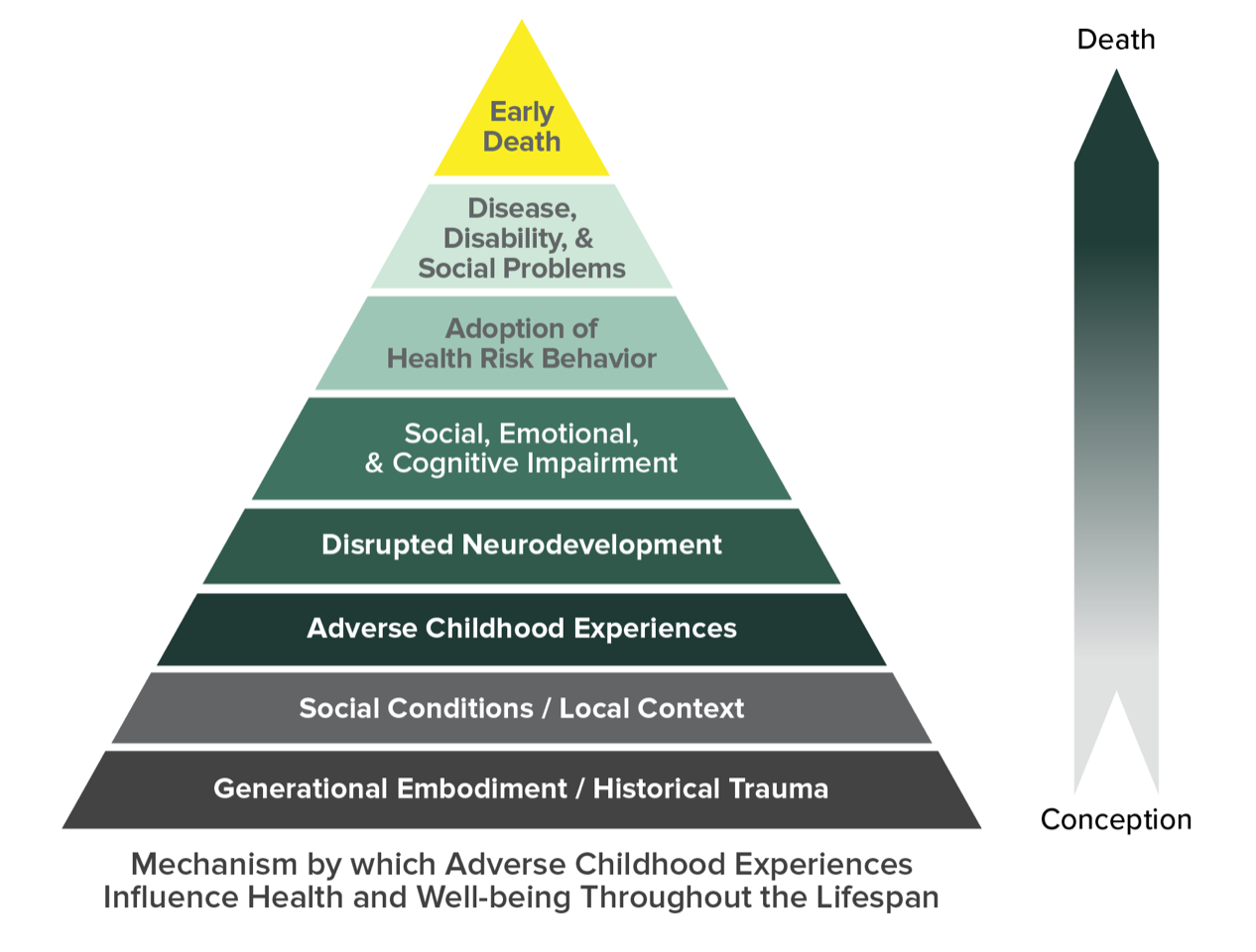
This is precisely where intensely brilliant and accomplished people like Nadine Burke Harris have outlined something practical that transformed me as a teacher. We are entering into a third decade with the Adverse Childhood Experiences study, and in the ELA profession, we should be engaging with this advancement of human understanding in a practical and humble way in our courses. 


Towards the end of this month, I’ll be starting the Independent Reading portion of the Pre-AP Literature course I teach. I’ve had the standard literary lens options for that assignment as part of my pedagogy for decades, leading back to my internship year at Quaker Valley Middle School in the early 00’s, using John Noelle Moore’s Interpreting Young Adult Literature: Literary Theory in the Secondary Classroom as the launching pad. Like most of us incorporating literary theory, a student could choose to read a novel referenced on the AP Free Response Essay prompts, such as Catcher in the Rye, with a class lens, feminist lens, race/ethnicity lens, or archetypal lens. These stalwarts of late 20th century ELA teaching have provided generations of intellectual growth within the classroom, especially when tied to the practice of the IA Richards/T.S.Eliot school of close reading. But they are due for additions, revisions, and among teachers, a larger pedagogical discussion of how those lenses serve the greater human good of our students beyond the measurable standards. I suggest we start by adding a new lens, one suited to acknowledge what neurology and mental health counseling have both confirmed about the decade-long proliferation of student anxiety, an essential learning barrier. We need to offer a trauma-informed lens as a literary analytical exercise, in the same fashion as the lenses of the past. 


I’ll be asking my students to consider the plot, the symbols, the characterization, the narrative point of view, and a number of other key literary elements that define how an author creates meaning in their text. That’s the core of literary analysis in the AP Literature classroom. But through a trauma-informed lens, I’ll be asking students to see where untreated trauma leads to further consequences in the setting of the story, for the directly traumatized, the people experiencing secondary trauma within the text, even those who might be sensitive to trauma in a text but may be suffering from compassion fatigue. We’ll use the ACES index as our concrete step for identification: 


https://www.cdc.gov/violenceprevention/aces/about.html?CDC_AA_refVal=https%3A%2F%2Fwww.cdc.gov%2Fviolenceprevention%2Facestudy%2Fabout.html

More specifically, without using the extensive questionnaire, students will use a general index for the ACES to view the character’s score:

ACEs Definitions

All ACE questions refer to the respondent’s first 18 years of life.

  • Abuse

    • Emotional abuse: A parent, stepparent, or adult living in your home swore at you, insulted you, put you down, or acted in a way that made you afraid that you might be physically hurt.

    • Physical abuse: A parent, stepparent, or adult living in your home pushed, grabbed, slapped, threw something at you, or hit you so hard that you had marks or were injured.

    • Sexual abuse: An adult, relative, family friend, or stranger who was at least 5 years older than you ever touched or fondled your body in a sexual way, made you touch his/her body in a sexual way, attempted to have any type of sexual intercourse with you.

  • Household Challenges

    • Mother treated violently: Your mother or stepmother was pushed, grabbed, slapped, had something thrown at her, kicked, bitten, hit with a fist, hit with something hard, repeatedly hit for over at least a few minutes, or ever threatened or hurt by a knife or gun by your father (or stepfather) or mother’s boyfriend.

    • Substance abuse in the household: A household member was a problem drinker or alcoholic or a household member used street drugs.

    • Mental illness in the household: A household member was depressed or mentally ill or a household member attempted suicide.

    • Parental separation or divorce: Your parents were ever separated or divorced.

    • Incarcerated household member: A household member went to prison.

  • Neglect

    • Emotional neglect: Someone in your family did not help you feel important or special, you did not feel loved, people in your family did not look out for each other or feel close to each other, or your family was not a source of strength and support.

    • Physical neglect: There was not someone to take care of you, protect you, or take you to the doctor if you needed it, you didn’t have enough to eat, your parents were too drunk or too high to take care of you, or you had to wear dirty clothes.

Using this lens will reveal the craft of the storytelling, an understanding of the storyteller’s choice to engage us in the suffering of their story world. What specific words elicit empathy from us? Are we to see that character as traumatized, from the author's perspective, through explicit sensory imagery or direct characterization? Can a student not only find direct textual evidence, but identify the inferences that suggest the conditions listed above? These are text-dependent questions the Language Arts teacher is uniquely qualified to measure, to instruct, and to assess.  Are we qualified to diagnose trauma? Not in a clinical sense. But in offering this lens, we not only expand close reading skills, but hopefully offer a few additional educational experiences about those who are qualified to diagnose and treat trauma. 


First, who do we identify with in the text? If we are not the traumatized, are we somehow an indirect or passive part of the people or setting that actively or passively allows the trauma to happen? We can re-see our own humanity, both shared and rejected, and aim to be more open and available to the people in the world around us and their suffering. Second, if a student finds this type of analysis fulfilling, maybe they have a future in pediatrics, psychology, mental health counseling, or other related fields? Third, for those aspiring to write realistic fiction or even any engaging storytelling regardless of genre, a close analysis of powerfully emotional and insightful text can springboard an emerging author into a deeper understanding of the intensity carefully crafted text can contain.  


This is certainly mature content, so I can not suggest this type of lens fits even in a 9th or 10th grade classroom. I asked school counselor Alaina Schrader, who works at the primary and elementary grade level, and she provided a suggestion for younger grades:
  Try using some basic neuroscience or knowledge of the brain as a lens to apply to characters in literature. For example... "What part of the character's brain was activated when _______ happened?, etc. Trauma-informed education is really understanding behavior through the neuroscience lens, and depersonalizing behavior based on how our brains are wired. So even a basic understanding of the triune brain model helps a person understand the behavior of others and show compassion. (She teaches the triune brain model to 4th grade students at Avonworth)


As a teacher of any grade level, knowing the ACES index is helpful. Hopefully using this trauma-informed literary lens can help the ELA teacher not just improve close reading skills, but also counter the larger impact of sorting and labeling that the standard literary lens lends themselves to. A trauma-informed lens acknowledges both how we as individuals have our unique struggles but also how we share the larger bond to care for each other as members of the human family.


Author’s Bio: Scott Tuffiash is a Language Arts Teacher and the Avonews Adviser at Avonworth High School.

Thursday, October 15, 2020

Maslow: Not Just for Our Students by Jacqueline Ahlborn

 Maslow: Not Just for Our Students

Whether you are teaching in a physical classroom, virtually, or in a hybrid mix, it’s safe to say, if you are like me, you are in the thick of it by now.  Educators carry a heavy load, and it is critical that we maintain a healthy balance between work and home, especially if we are teaching from home.  Now more than ever the lines are blurred.  Educators are always encouraged to take time out for self-care, and now more than ever this is vital.  Self-care can help to provide harmony in our lives and reduce tension.  Here are a few strategies in order to help us become more attuned to our needs as teachers in both a remote learning environment and a physical classroom so that we may be mentally and physically prepared every day to meet our students’ needs.  


Teaching from Home:  A Starting Point


Hopefully everyone by now has designated a dedicated work space within their homes.  This is an important step in teaching remotely that may not be viewed as an essential aspect when discussing self-care.  Not only can a designated work area help to support functionality and productivity, but it can assist in clearing that blurred line between work and home.  A clearly defined work area allows you to leave your work whether it is for the day or for a few moments to stretch and take a breather from teaching.  Your home still needs to remain your sanctuary, so defining an area for work can help you separate your work demands from the place where you relax and unwind.


Work Zone:  Do Not Disturb


When working remotely, it is essential that you set guidelines with your family.  There are crucial times that you cannot be available, and there is a need to communicate this in order to prevent interruptions.  You can plan a set of scheduled breaks or create subtle cues as to when you are available within your work day.  If you cannot be interrupted, you can express this by posting a sign that indicates you are busy, closing your door, asking the person to text you their needs, or connecting during one of your planned breaks.  If there would be an urgent or specific need, define what that would be and the protocol for addressing it.


Are Your Needs Being Met?


I tuned into a podcast recently which had me thinking about self-care during this rare moment in our history.  Tina H. Boogren, Ph.D, addresses Maslow’s Hierarchy of Needs in her webinar “Self-Care for Educators in the Time of COVID-19 and Beyond”.  She referenced a survey from Yale/CASEL that indicated 5,000+ teachers listed anxiousness as one of the top feelings they are experiencing right now.  


The strategies she suggests align with Maslow’s Hierarchy of Needs and begins with Level 1(Physiological): Getting back to the basics in reference to diet, sleep, and exercise.  She reminded us of how very important it is to drink lots of water.  Level 2 (Safety): Order, predictability, and fairness.  When there is not a sense of safety, it can bring a feeling of anxiety.  We need to remember to engage in breathing exercises during these times.  Level 3 (Belonging and Love): If level 1 and 2 are not met, we will have a difficult time obtaining Level 3.  We need to remember to engage in social connections with others.  Level 4 (Self-Esteem):  We may feel like first time teachers during this unique time of teaching.  Try not to compare yourself with others and utilize positive self-talk.  Level 5 (Self-Actualization):  Find your best self and reconnect with yourself!  Focus on gratitude and altruism.  When we ask ourselves if these needs are being met on a daily basis and we are finding that the answer is an astounding “no”, we need to employ strategies to make it a “yes”.  If not, we can experience negative emotional and physical consequences and will have an adverse impact on our motivation and creative thinking.  These needs allow us to feel fulfilled, so it is important to determine what our needs are and how we can proceed in having them met. 


It is critical that educators maintain a healthy balance between work and home, especially if teaching from home.  Taking time out for self-care is more vital than ever and can help to provide harmony in our lives and reduce tension.  We are in a unique teaching situation, and we need to remember to care for ourselves so that we may be mentally and physically prepared to rise up to meet our own students’ needs every day.  To listen to the podcast in full, the following link is attached: https://home.edweb.net/webinar/pd20200522/.


Author’s Bio: Jacqueline Ahlborn’s teaching experience spans over private and public schools where she has been a teacher for a total of nineteen years.  Currently, she is in her sixteenth year teaching special education in Pittsburgh Public Schools.  She has earned a Doctorate in Educational Leadership from Duquesne University.  Jacqueline enjoys reading, writing, and spending time with her family, especially with her five-year-old grandson.


Thursday, October 1, 2020

Black Students Need their Teachers to See Color; White Students Need it Too by Janel Prinkey

Black Students Need their Teachers to See Color; White Students Need it Too


White Fragility by Robin DiAngelo has been flying off of shelves, sneaking into mailboxes, and lighting up eReaders ever since the murder of George Floyd on May 25, 2020. It seems as though America is ready to face some of its subconscious racism, consciously. But where does that leave teachers, and what is our role? What stance should we take when everything about our careers has been politicized, and even weaponized, since COVID-19 has stopped the world from turning? WPCTE chose White Fragility as the September Book Club selection.

Black Students Don’t See Themselves Reflected in Schools

Pennsylvania’s teachers are overwhelmingly white, and this impacts the way that Black students and staff experience education. Only 4% of teachers in Pennsylvania are Black, which ranks the state 47th in the disproportionality rate between Black students and white teachers in the United States of America according to Research for Action in their April 2018 policy brief. If teachers in Pennsylvania adopt the fear that DiAngelo refers to when discussing race, whether it be fear for their jobs or fear of being labeled as racist, all students lose--but Black students lose the most. Worse, if white teachers are subconsciously racist by expecting less from their Black students, treating them as different from the “norm”, or asking them to represent all Black people in their viewpoints in class discussions, they are alienating and discriminating against them. DiAngelo emphasizes that racism, contrary to popular belief, does not have to be intentional. It is not enough for teachers to not be racist. Instead, we must actively be antiracist.


Doing Antiracist Work is Uncomfortable


Teaching is a profession that prides itself in caring for children and wanting them to be the best possible versions of themselves. This requires not only professional development in the form of learning more about your subjects and classroom management, but should also include adjusting the perceptions we have about our students. Are we surprised that one of the few Black students we have turned in an assignment? If we are, why is that? What have we been conditioned to believe about Black people and how successful they are in school? In life? By examining these beliefs head on instead of pretending to not know that they exist, we allow Black students to receive the same quality education that their white peers receive.

Additionally, white students have similar misconceptions and sometimes voice blatantly racist remarks. Time should be spent to explain to students why the terms they are using are inappropriate and cause harm, and why they should not feel slighted by programs like Affirmative Action. White people have many challenges in life. One of those challenges, however, has not been the color of their skin. That is the point that DiAngelo is trying to make, and that we should illustrate for all of our students. Systemic racism exists, and pretending that it does not makes us complicit in its inequity and the benefits that we receive from it.


“Reverse Racism” is a Dangerous Myth


Oftentimes white students in my classes are heated about the topic of racism because they believe that they or their families have been the victims of racism. They mention instances of not getting accepted into colleges that their fellow Black students are going to, being denied a job that ultimately went to a person of color, or experiencing discrimination at the hands of Black people from a social view. This is dangerous thinking, as DiAngelo explains only whites can be racist. This is due to the source of power and who can be denied a voice or a position of power by those people. Because Black people do not fill the majority of these positions of power, you cannot be a victim of racism at the hands of a Black person who cannot fundamentally change your life. Explaining this to students will be uncomfortable at best. But to continue to allow students to believe that the reason that they have not achieved their goals is because a Black person took their spot, is insulting and entirely erroneous. It also never allows for a situation where a Black student would outperform a white student, and that perpetuates white supremacy. Interceding on the behalf of Black people, even if you do not have Black students, is important to the development of your white students’ viewpoints as well.


Conclusion


As teachers, we have a responsibility to all of our students to prepare them for a life in America, one of the most diverse countries in the world. To not refute racism in all forms, to not blatantly teach antiracist ideas, is to condone them. It is a harmful methodology to “not see color” because you are ignoring a fundamental part of a person’s experience. Do you also not see low socioeconomic status? Gender?  Hair color? It would be absurd to ignore these things with our students, so we must see color. We must teach our students to reject the noxious fumes of racism that is in the very air that we breathe in America. Remember to put your oxygen mask on first.


Author Bio: 

Janel Prinkey teaches 7th and 8th grade Reading for a rural school district in Western Pennsylvania. She is an avid reader and writer and enjoys spending time with her Yorkiepoo, Arya.

A Nightmare on ELA Street: Designing a Horror Lit Elective by Jason M. Kosmiski

 A Nightmare on ELA Street: Designing a Horror Lit Elective by Jason M. Kosmiski, WPCTE Secretary Last year, R.L. Stine spoke at the PennWe...