When invited to write a blog about MG/YA books that I would recommend to read through the year, I immediately thought about suggesting books to read through themes related to each month. I wanted to share recently-published novels/memoirs of different reading and interest levels, featuring culturally diverse authors or characters and settings, written at a variety of reading and interest levels, in a variety of formats: prose, verse, graphic, or multi-formatted. Because of all the advantages to reading in book clubs outlined in Part 1 of this blog (posted in January 2022), I strongly advocate for employing these books in topic (or character, setting, genre, or format) book clubs whenever possible.
Part 1 of this guest blog took readers through the first half of the year with suggested texts for each month that could be employed for book club or for independent, self-selected reading choices on a topic. Each month presents choices of novels or memoirs that book clubs or individual readers can read. Choice has been found to be a prime motivator in turning adolescents into readers. A meta-analysis of 41 studies examined the effect of choice on intrinsic motivation and related outcomes in a variety of settings with both child and adult samples. Results indicated that providing choice enhanced intrinsic motivation, effort, task performance, and perceived competence, among other outcomes (U.S. National Library of Medicine). The lists presented for each month are only examples from books I have read, but teachers should provide enough books or titles to allow for choice. See Part 1 with my reading suggestions from January through June: https://wpcte.blogspot.com/2022/01/2022-mgya-book-recommendations-month-by.html.
Summaries of all these novels are available on Goodreads, and my review of many are available on my Goodreads account or my Facebook Page (https://www.facebook.com/lesley.roessing) under #TalkingTexts or #BooksThatGenerateImportantConversations.
I will begin this Part 2 with some ideas about Summer Reading. If you or your school require(s) a summer reading, you may consider offering a choice of novels on a topic or theme, letting readers choose novels based on their own reading comfort levels from a variety of authors, characters, settings, and formats—prose, verse, and graphic. When students return to school, they can group themselves into book clubs to discuss their novels and prepare presentations to the rest of the class, thereby creating a Reading Community at the very beginning of the year. Students who transfer into the school on the first days can read a short story and conduct some light research on the topic to add to a club’s presentation.
* * *
It is important that readers see their lives and cultures reflected in story as well as learning about others’ lives and cultures through books. In February I suggested books for the African-American Read-In and, in May, books written by authors and /or featuring characters for Asian Pacific American Heritage and Jewish American Heritage Month.
JULY
Books Of Summer
While readers are experiencing summer they can be reading about characters who are doing the same (although most characters will be experiencing more conflict than, hopefully, our readers).

Books for readers of grades 4-8:
Crashing in Love
Shouting at the Rain
From the Desk of Zoe Washington
Chirp
One Crazy Summer
Consider the Octopus
The House That Lou Built
Silver Meadows Summer
All of Me
The Summer of Owen Todd
Somewhere Among
Olive’s Ocean
Orchards
The Season of Styx Malone
The Summer Before Boys
To Night Owl from Dogfish
Books for YA Readers:
Your Heart; My Sky
Exit, Pursued by a Bear
Paradise on Fire
When Dimple Met Rashi
Hope Was Here
The Summer of Letting Go
Honor Girl
South Asian Heritage Month (celebrated July 18—August 17 in the UK; in May in US)
South Asia is composed of eight countries: Bangladesh, Bhutan, India, Maldives, Nepal, Pakistan, Sri Lanka, and Afghanistan.
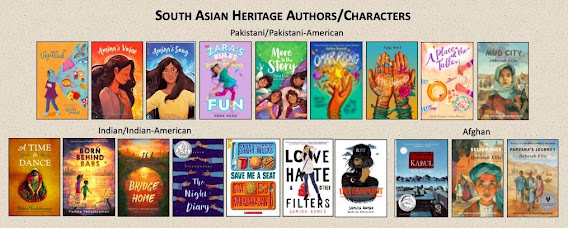
Some novels I would suggest with characters of South Asian heritage are
Unsettled
Amina’s Voice and Amina’s Song
Zara’s Rules for Record-Breaking Fun
More to the Story
Omar Rising
Amal Unbound
A Place at the Table
Mud City (The Bread Winner #3)
A Time to Dance
Born Behind Bars
The Night Diary
Save Me a Seat
Love, Hate & Other Filters
Internment
Shooting Kabul
The Breadwinner and Parvana’s Journey
July 4 United State Independence Day: Another appropriate topic for July would be American independence or choosing a historical fiction novel relating to the Revolutionary War, such as
Chains, Forge, and Ashes
The Fighting Ground
Sophia’s War
or, as a twist, any novels that readers choose and interpret as relating to any type of independence.
AUGUST
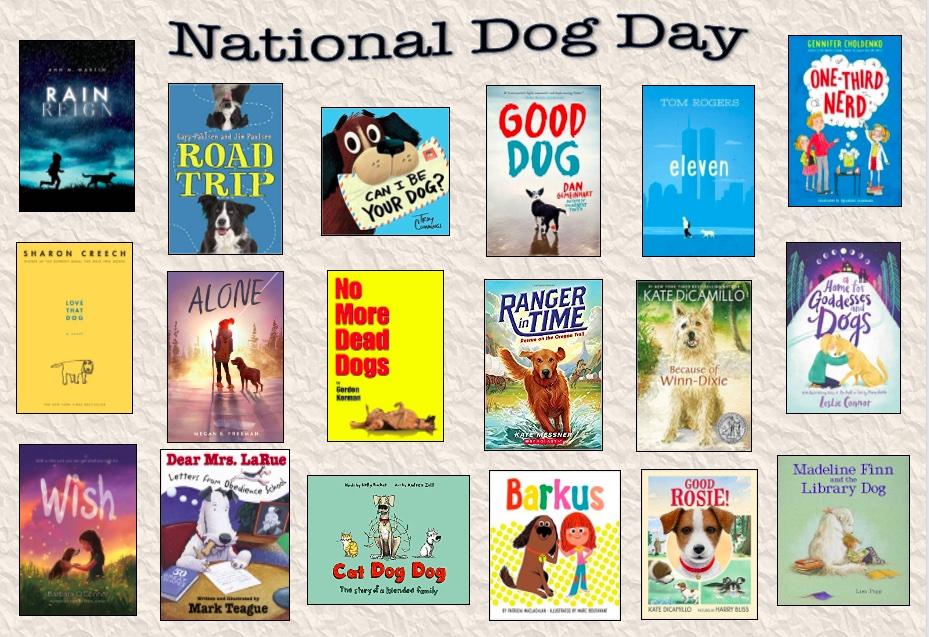
August 26 National Dog Day: reading books that feature dogs
August 30 National Grief Awareness Day:

These are some novels I would suggest for grade 4-8 readers. Teachers can divide this list among grade levels, based on the ages of the main characters.
The Stars Beneath Our Feet
Free Verse
The Incredible Journey of Coyote Sunrise
Mockingbird
Maybe a Fox
Denis Ever After
The Shape of Thunder
Planet Earth is Blue
The Summer of Letting Go
Counting by 7s
Locomotion
Pieces of Georgia
When You Trap a Tiger
A Home for Goddesses and Dogs
Give and Take
In Your Shoes
A Comb of Wishes
Isaiah Dunn is My Hero
Red, White and Whole
Sweeping the Heart
Miracle’s Boys’
The Someday Suitcase
Seven Clues to Home
The Thing about Jellyfish
The Truth as Told by Mason Buttle
The Dollar Kids
Bridge to Terabithia
These are some novels I would suggest for High School readers that educators could divide into Book Clubs based on the type of loss:
Coaltown Jesus
How to Build a Heart
All We Have Left
Long Way Down
The Secrets We Keep
All the Bright Places
I Am Not Your Perfect Mexican Daughter
Sadie
Bang
A List of Cages
Up from the Sea
The Boy in the Black Suit
Seeing Red
The Usual Rules
Rebound
Fanboy and Goth Girl
Clap When You Land
Hope and Other Punch Lines
Boy 21
In Sight of Stars
Paradise on Fire
Parkland Speaks
Patron Saints of Nothing
The Fault in Our Stars
The Hate U Give
After the Death of Anna Gonzalez
Monday’s Not Coming
Wintergirls
SEPTEMBER
September 11:
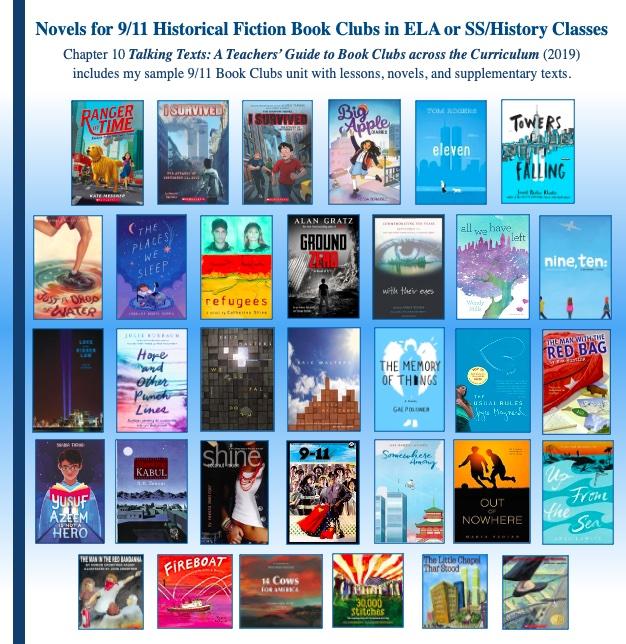
No historical event may be as unique and complicated to discuss and teach as the events of September 11, 2001, the day terrorists crashed planes into, and destroyed, the Twin Towers of the World Trade Center. At the time of this event, no child in our present K-12 educational system was yet born, but, in most cases, their parents and educators would have been old enough to have some knowledge of, and even personal experience with, these events, making this a very difficult historic event for many to teach. However, with the devastation and impact of these events on our past, present, and future and as ingrained a part of history these events are, they need to be discussed and understood as much as possible.
I have found the most effective way to confront difficult topics while still presenting a variety of perspectives and differentiated reading experiences for our diverse readers is through reading in book clubs. It has been eye-opening—and rewarding—to visit schools and facilitate book clubs using novels written about the events of 9/11 from differing perspectives. I have reviewed most of the novels, memoirs, and graphica pictured below in a guest-blog for YA Wednesday: http://www.drbickmoresyawednesday.com/weekly-posts/20-mgya-novels-1-graphics-collection-to-commemorate-the-20th-anniversary-of-911-by-lesley-roessing
September 15-October 15 Hispanic Heritage Month:
Here is a list of novels and memoirs in a range of reading levels with a diversity of Hispanic/Latinx characters and settings, written and formatted in prose, verse, and graphics, written by a variety of authors, many of which are of Hispanic/Latinx heritage themselves.
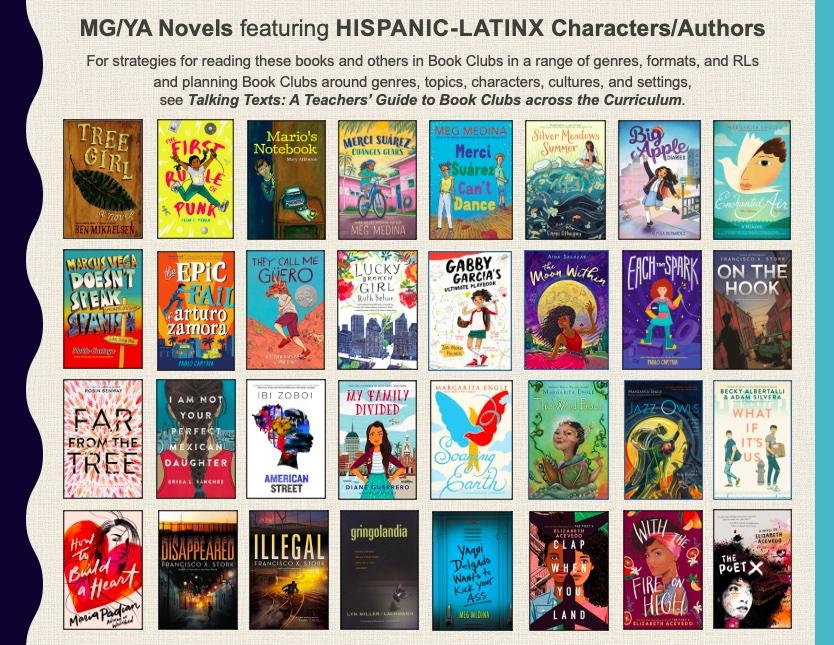
For late elementary and middle-grade readers:
Tree Girl
The First Rule of Punk
Mario’s Notebook
Merci Suarez Changes Gears and Merci Suarez Can’t Dance
Silver Meadows Summer
Big Apple Diaries (memoir)
Enchanted Air (memoir)
Marcus Vega Doesn’t Speak Spanish
The Epic Fail of Arturo Zamora
Lucky Girl
Gabby Garcia’s Ultimate Playbook
The Moon Within
Each Tiny Spark
And YA novels:
On the Hook
Far from the Tree
I Am Not Your Perfect Mexican Daughter
American Street
My Family Divided (memoir)
Soaring Earth (memoir)
The Wild Book
Jazz Owls: A Novel of Zoot Suit Riots
What If It’s Us
How to Build a Heart
Disappeared and Illegal
Gringolandia
Yaqui Delgado Want to Kick Your Ass
Clap When You Land
With the Fire on High
The Poet X
OCTOBER
National Bullying Prevention Month
Bullying is unwanted, aggressive behavior among school-aged children that involves a real or perceived power imbalance. A type of youth violence that threatens young people’s well-being, bullying can result in physical injuries, social and emotional problems, and academic problems. According to the National Center for Education Statistics and Bureau of Justice Statistics, 28% of U.S. students in grades 6–12 experienced bullying. In surveys, 30% of young people admit to bullying others. In one large study, about 49% of children in grades 4–12 reported being bullied by other students at school at least once during the previous month, whereas 30.8% reported bullying others during that time.
It is imperative that teachers and especially students discuss bullying more in schools, especially in the middle grades where research shows that the most bullying takes place, and especially because many bullies and victims of bullying do not even recognize that bullying is occurring. These conversations occur more effectively though the reading of novels and memoirs. Students are more inclined to talk about how characters handled or mishandled situations than to analyze their own actions or those of their peers.
There are many well-written novels that feature bullying and can generate these conversations. Some middle grade novels that feature bullies, bystanders, and upstanders that I recommend for Book Club reading are
Restart
Lily’s Promise
Orchards
The Revealers
Squint
Say It Out Loud
And a few YA novels
Winning
Forget Me Not
How We Roll
Junk Boy
Stick
October Mourning: A Song for Mathew Shepard

Filipino American History Month
While there is not a Filipino Heritage Month, readers can celebrate their culture or learn about the culture of those who live in or emigrated from the Philippine Islands in honor of Filipino-American History Month. Most of these novels—written by Erin Entrada Kelly, Chris Baron, and Mae Respicio—are recommended for grades 4-8 while Randy Ribay writes YA novels; Shelly Brown and Chad Morris’ Squint includes a Filipino-American support character.

NOVEMBER presents multiple opportunities for reading on a whole class topic.
Native American Heritage Month

Indian No More
Apple in the Middle
Code Talkers
I Can Make This Promise
The Absolutely True Diary of a Part-Time Indian
The Pumpkin War
Walk Two Moons
The Sea in Winter
Rain is Not My Indian Name
Rez Dogs
Hearts Unbroken
Dreaming in Indian, an anthology
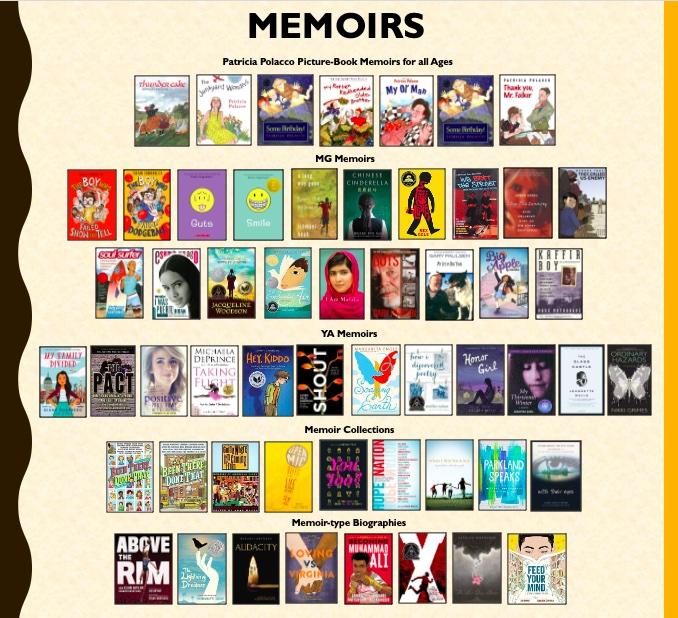
Family Story Month – Memoir
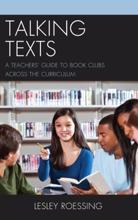
For reading-writing memoir and reading-like-a-writer, see BRIDGING THE GAP: Reading Critically & Writing Meaningfully to Get to the Core. For strategies for reading memoirs in Book Clubs, see TALKING TEXTS: A Teachers’ Guide to Book Clubs.
To read reviews of many of these memoirs, see my guest-blog for YA Wednesday, “Memoirs for Reading and Writing”: http://www.drbickmoresyawednesday.com/weekly-posts/memoirs-for-reading-and-writing-by-lesley-roessing
November 8 – STEM Day
There is a value for novels in many disciplines. As readers can learn history from reading historical fiction novels, and they can learn science and math, including how science and math fits in the real world, through reading novels and memoirs. Students can read in science and math classes or in ELA classes or with the collaboration of both sets of teachers across the curriculum.
“Although many disciplinary teachers may feel that there is not enough time to cover state standards and read novels in their classes, they may be surprised how much content students learn and how many standards they meet through novel book club reading and the ensuing discussions. And when students in each club read and present on a different novel, feasibly on a different topic covered in the curriculum, the class as a whole learns from the reading of all the novels” (The Write to Read, Ch 9).

MATH
Grades 4-8:
The Phantom Tollbooth
Solving for M
Miscalculations of Lightning Girl
The Numbers Devil: A Mathematical Adventure
Seven Clues to Home
Girls Who Code series
All of the Above
MG and YA editions:
Hidden Figures
Grades 9-12:
An Abundance of Katherines
Secrets, Lies, and Algebra
Flatland: A Romance of Many Dimensions
SCIENCE
Grades 4-8:
Fever, 1793 (Yellow Fever epidemic)
The Pumpkin War (farming)
The Infinite Lives of Masie Day
Song for a Whale (cetology)
The Fourteenth Goldfish (mortality)
The Thing about Jellyfish
The Someday Suitcase (symbiosis)
Saving Wonder (coal mining)
Counting by 7s (nature)
Smack Dab in the Middle of Maybe (environment)
The Incredible Magic of Being (astronomy)
Beyond Me (tsunami aftershocks)
The Someday Birds (ornithology)
Consider the Octopus (Great Pacific Garbage Patch)
Rocket Boys, memoir (rockets)
Chomp (animals)
Hoot (environment)
Flush (sewage dumping)
Scat (swamp ecology)
Finding Wonders: Three Girls Who Changed Science (metamorphosis, fossils, astronomy)
Chasing Secrets (plague)
Anyone Here Seen Frenchie?(geology)
The Star Outside My Window (astronomy)
Planet Earth is Blue (astronomy)
A Swirl of Ocean
Code Orange (viruses)
Your Heart; My Sky
Grades 9-12:
Paradise on Fire (fire)
A Civil Action (water contamination)
The Immortal Life of Henrietta Lack (cell research)
Up from the Sea (tsunami)
Ringside, 1925 (Scopes Trial)
A Death-Struck Year (1918 Influenza Pandemic)
DECEMBER
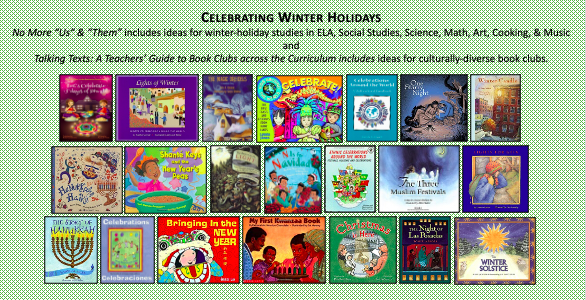
Winter Holidays
“There are many winter holidays that are celebrated around the time of the Christian Christmas, and there are many ways that holidays and the spirit of celebrations can be acknowledged in a nondenominational and secular fashion. When students read stories about holidays with which they may be unfamiliar, reading books, adding research, decorating the classroom, making presentations, creating puppet shows, performing skits, or otherwise sharing their research, everyone is valued.” (No More “Us” and “Them”: Classroom Lessons & Activities to Promote Peer Respect, Ch.7)
Universal Human Rights Month: Ending the Year with a study of Social Justice and Human Rights
There are countless novels recently written on this theme under a variety of topics. These are samples of some of my favorite MG/YA Social Justice novels.
March 1, 2, and 3 – graphic novels
Monster – graphic novel
Yummy: The Last Days of a Southside Shorty– graphic novel
House Arrest– verse novel
Loving vs Virginia– verse novel
Kent State– verse novel
Long Way Down– verse novel
Middle Grades – grades 4-8
Born Behind Bars
A Good Kind of Trouble
All Rise for the Honorable Perry T. Cook
From the Desk of Zoe Washington
Front Desk and Three Keys
Blended
Omar Rising
Fast Pitch
Ghost Boys
You Don’t Know Everything, Jilly P!
I Can Make This Promise
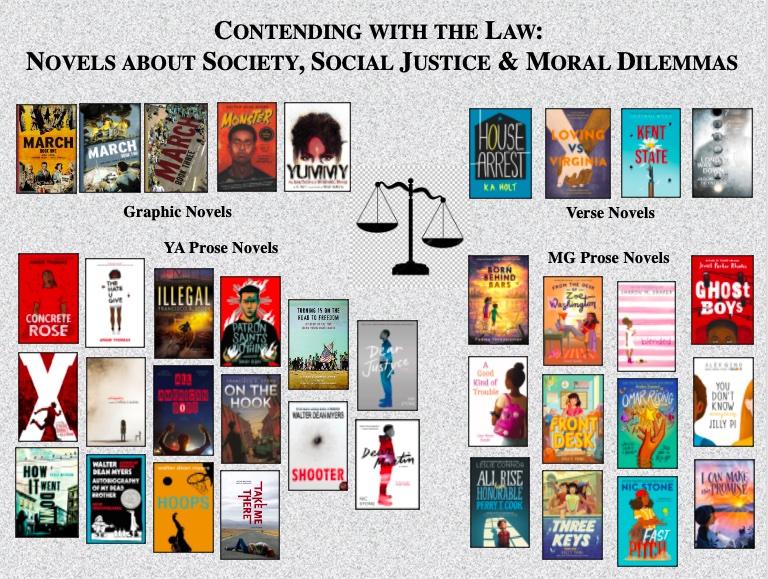
Human Rights
I taught an 8th grade Humanities class centering on the theme of Human Rights and Issues of Intolerance. We began with the “Universal Declaration of Human Rights” and read novels about human right issues and violations such as the Holocaust, Apartheid, Native American rights, rights of citizens with disabilities, rights of free speech, etc., through whole-class, book clubs, and individual self-selected readings. Novels can be read in Social Studies/History classes with each book club reading a different novel about the same issue (Apartheid) or with each book club reading a novel about a different Human Rights issue.
* * *
There are many ways to employ books in a classroom setting to read as a community, whether reading a whole-class novel or reading in book clubs or individually on a topic such as those shared in this 2-part guest-blog as readers read through the year. It is important that readers be encouraged to read diversely whether by topic, characters, setting, authors, genre, or writing format.
For strategies and lessons for reading and discussing not only novels/memoirs, but short stories, poetry, nonfiction books and articles, and textbooks, in book clubs, see Talking Texts: A Teachers’ Guide to Book Clubs across the Curriculum.
* * *
A middle school and high school teacher for twenty years, Lesley Roessing was the Founding Director of the Coastal Savannah Writing Project at Georgia Southern University (formerly Armstrong State University) where she was also a Senior Lecturer in the College of Education. In 2018-19 she served as a Literacy Consultant with a K-8 school. Lesley served as past editor of Connections, the award-winning journal of the Georgia Council of Teachers of English. As a columnist for AMLE Magazine, she shared before, during, and after-reading response strategies across the curriculum through ten “Writing to Learn” columns. She now works independently, writing, providing professional development in literacy to schools, and visiting classrooms to facilitate reading and writing lessons. Lesley is the author of
Bridging the Gap: Reading Critically & Writing Meaningfully to Get to the Core
Comma Quest: The Rules They Followed. The Sentences They Saved
No More “Us” & “Them: Classroom Lessons and Activities to Promote Peer Respect
The Write to Read: Response Journals That Increase Comprehension
Talking Texts: A Teachers’ Guide to Book Clubs across the Curriculum
and has contributed chapters to
Young Adult Literature in a Digital World: Textual Engagement though Visual Literacy
Queer Adolescent Literature as a Complement to the English Language Arts Curriculum
Story Frames for Teaching Literacy: Enhancing Student Learning through the Power of Storytelling
Fostering Mental Health Literacy through Adolescent Literature