Monday, May 1, 2023

The Persistent Narrative of Learning Loss in the Face of Genuine Student Needs by Hannah Lewis

The Persistent Narrative of Learning Loss in the Face of Genuine Student Needs
by Hannah Lewis

Teachers, how tired are we, as we navigate this year’s standardized testing sessions, of hearing about learning loss? If you are like me, the term triggers clenched teeth and rolled eyes. So when I saw this PBS segment earlier this month about how parents’ perceptions of their children’s grade level performance were not “accurate,” I thought, Oh, a new angle to stoke alarm about how doomed this generation of children are academically…

Does this mean that I don’t care about my students’ learning, or about how accurately parents understand their children’s academic performance? I like to think not. I tend to hold my students to what I consider to be quite high standards, and to dialogue regularly and specifically with parents and caregivers about students’ performance. 

So what’s my beef–what’s our beef, perhaps–with this language? 

The fact of the matter is, my issue is twofold. 

Academics at the Expense of Social-Emotional Needs

First, the kids are not alright, and that should be the primary focus of everyone in education or who works with children in any capacity. In March, the CDC released a report that, in my mind, painted a much grimmer picture than any set of test scores I’ve ever seen. One in five teen girls has experienced sexual violence in the last year. Three in five felt “persistently hopeless.” One in four seriously contemplated suicide. And LGB teens reported similar concerns. Make no mistake: these statistics should alarm us all. 

I have always hated that old saying we hear so often in “trauma-informed” professional development sessions: “You have to Maslow before you can Bloom.” I don’t believe that’s true. Many of our students experience ongoing trauma, chronic stress, homelessness, food insecurity, and other obstacles; they are still capable of learning. That said, when students are so persistently traumatized and sad, I am not sure that reading remediation programs and math drills are the best solution for their mental, emotional, or academic progress. 

Reading and writing are incredibly powerful tools to leverage for social and emotional healing. At the WPCTE HOPE through JOY conference, one of the most powerful sessions I attended, Dr. Richard Koch’s “Trauma-Informed Teaching is an Act of Love: Building it in Our Classrooms,” explored how to ignite students’ enthusiasm for writing through authentic and mindful writing opportunities. Not once do I recall Dr. Koch mentioning students’ grade levels or career readiness–but of course, students who are enthusiastic about writing, and who associate writing with positive self-perception, will engage with it more and will get better at it, by whatever arbitrary metrics we choose to use to assess them.

What Even is a "Grade Level"?

And that arbitrariness is my second complaint. When we say students are reading at a second-grade level or a tenth-grade level, these numbers really don’t mean anything. Half of U.S. adults read at or below what we consider a sixth-grade level. This information raises the question, “Why do we expect seventh-graders to read better than their parents?”

Obviously (at least I hope it’s obvious!) I’m not suggesting that students who reach what we consider to be a sixth-grade reading level are done learning. Rather, I just want to point out that this categorization is random and arbitrary and reflects little. To develop students’ reading levels, we should introduce them to high-interest, rich, engaging texts that they will approach with curiosity and work to understand. Instead, what we too-often do when faced with a deficit-remediation model is drill students with passages that mean little to them and standards-aligned questions for them to answer correctly or incorrectly. My preference would be to engage them in authentic conversations about characters’ dilemmas, how they navigate the world, and what the author of a text is suggesting about life. 

It’s easy to see these complaints and say that I’m just a disgruntled teacher who wants to accept students’ abilities as just being what they are and not push them to achieve more. That couldn’t be further from the truth. 

As I wrote back in June of 2021, when WPCTE read Dr. Gholdi Muhammad’s Cultivating Genius for book club, “I’m trying to reframe my thinking slightly to instead consider how to leverage students’ diverse experiences of this past school year to cultivate genius.” Cultivating genius does not mean holding children to arbitrary “grade level” standards and framing their current levels as “deficient” if they don’t meet that arbitrary standard. Neither, however, does it mean that students should not be challenged. 

This year, some of the work I’ve done to engage students in meaningful ways that have allowed them to leverage their diverse experiences include:

  • Code-switching lessons that require students to read in dialect and reflect on their home languages and dialects and the privileges they enjoy or don’t enjoy as a result 
  • Free-writes on high-engagement topics such as their perceptions of entrenched wealth in society, their opinions about the impact of nature on their lives, etc. 
  • Class discussions that connect difficult rich readings like Their Eyes were Watching God, The Scarlet Letter, The Crucible and A Raisin in the Sun–to name a few–to their own lives, experiences, and values
  • Poetry lessons that challenge students to define, reexamine, and redefine what qualifies something as a poem, considering American Sign Language, concrete poems, spoken-word poems, and ars poeticas as examples

When it comes to how parents see students' progress, I don’t spend a lot of time talking to them about the “grade level” at which their child reads. Of course, if I notice their child is struggling with the coursework, I point it out; they generally already know. But what I have tried to do this year, and what I will continue to do, is to talk to parents specifically about how their child is doing socially (yes, even in eleventh grade; and, yes, even at a cyber school); how their child is handling the workload and stress of the school year; how enthusiastic their child is about their coursework; how engaged their child is in class discussions; and what they and their child might need from me to facilitate student learning. 

I hope that this kind of dialogue is more fruitful than a conversation “correcting” parents’ perceptions of their child’s “grade level performance” might be. 

Saturday, April 1, 2023

Artificial Intelligence: Chat Bots and Language Models in English Language Arts By Hannah Lewis

Artificial Intelligence: Chat Bots and Language Models in English Language Arts 

Are We Doomed?

By Hannah Lewis

This month, I had the incredible opportunity to participate in WPCTE’s HOPE through JOY conference at Penn West University in California, PA. This conference brought together educators from all over the region, and I was delighted to hear from teachers in such a wide variety of settings and contexts.

Regardless of our contexts, one issue impacting all of us in education (and, honestly, in a variety of other fields) is the role artificial intelligence technologies–language models/chatbots like ChatGPT in particular–are going to play in our lives, careers, and classrooms. 

While I came prepared to demystify these technologies and think through what they mean for our classrooms, I was delighted to see that another group of presenters from Grove City College (Fecich et. al.) had come to talk about the same topic. Their presentation and resources (linked here and available in the conference resources) solidified for me the relevance of the topic to educators at a variety of levels.

This topic began to interest me in December 2022 when I noticed that many of my students’ essays about Edgar Allan Poe’s role in American Romanticism contained similar features and all seemed to reference Arthur Conan Doyle. The culprit, I quickly discovered, was ChatGPT. 

While my initial reaction to plagiarism is always frustration and a little reflexive anger, I talked with my 11th-grade English colleagues and we slowly began to see this as a learning experience and to embark on a journey of exploration together. 

Our journey went something like this:

We were terrified that students would never write a paper themselves again.

We were arrogant enough to think we could create lessons to evade the problem– “ChatGPT can’t include direct text evidence and citations–we’ll just have to put that on all our rubrics now!”

We were at once both highly critical of and highly impressed by the essays ChatGPT could produce.

We eventually landed in a healthy place, where we established that, indeed, these types of A.I. are going to be with us for the rest of our careers, and we have to find a way to coexist with them.

That place of eventual, tenuous peace is the place from which I created my presentation, with a tremendous amount of help from my colleague and friend Abby Weller-Hall and acquaintance and applied data scientist Anthony Olivieri. 

My presentation can be found here, with links to activities and resources, but the key takeaways can be found below:

  • Chatbots are not actually intelligent or learning. Indeed, they are highly sophisticated and impressive pieces of technology and can (as Fecich et. al. describe) serve as very helpful productivity tools for educators and other professionals. However, they cannot think critically or creatively and, therefore, cannot replicate the most important skills we aim to teach in the English Language Arts classroom. 
  • Plagiarism has been around forever and will always be a problem, as long as students are incentivized to work for something other than the experience of learning (grades, accolades, acceptance from teachers or peers, etc.). While tools exist to help spot cheating (like this excellent resource from CommonLit and Quill that not only provides a chatbot plagiarism “detector” but also a guide for how to approach the issue), we will always miss something. We cannot expect ourselves to perfectly catch cheating every time it happens. Instead, we should focus on creating assignments that are meaningful and engaging and convince students of their value so that, to the extent possible, they are motivated to do the assignments for the inherent value they have, not just for the grade. 
  • Similarly, technology continually inspires fear. Socrates resisted the written word, math teachers resisted calculators, and English teachers resisted spelling and grammar checkers, but now all of these tools have improved teaching and learning, allowing us to move beyond lower Depth of Knowledge skills and teach higher-level thinking skills. The same will be true for ChatGPT and other language models–we just have to figure out how to coexist with and, eventually, leverage them, just as we have every other piece of technology.

Most vitally, these tools give us an opportunity to reexamine what we do in the English Language Arts classroom. 

  • While these tools are very good at writing unimaginative, template-like essays, they consistently fail to go deeper and, for example, write engaging introductions or thoughtful conclusions. This is our chance to move away from teaching boring, formulaic writing structures like the five-paragraph essay. Instead, we can take this opportunity to invite students to engage with how books connect to their lives and the implications they have on the world around them. Not only will reimagining writing in this way engage students more and make them less likely to want to plagiarize–they will simultaneously make plagiarism more challenging, since algorithms do not have lives or experiences to tie these pieces into. 

While I’m still working to find ways to engage with ChatGPT and other language models, you can find some of Abby's and my attempts to leverage ChatGPT essays to teach critical thinking in writing here and here, respectively. 

Let’s not sound like fearmongers or Luddites. Let’s find a way to live with and, ultimately, leverage these technologies to make our lives easier and teaching and learning better!

To see more of the great ideas from educators around the region, check out the conference website here and be sure to join us in 2024!

Wednesday, March 1, 2023

Educating for Peace by Natalie S. Barkovich

Educating for Peace by Natalie S. Barkovich

In my time as a high school and middle school English teacher, I have had the opportunity to team up with Social Studies colleagues in order to create ELA and History integrated courses.  Currently, I co-teach ELA Civics for eighth graders, and we infuse reading, writing, and research instruction with the Civics content. The first integrated course that I took part in was a tenth grade English, World History, and Art course designed for students to deepen their understanding of World History with literature, writing, Art History, and student-created art. My first foray into integrating my English classroom with history helped me to see the power of memoir, historical fiction, poetry, art, and student writing to help students better understand complex historical events. That course resulted in a collaboration with Classrooms Without Borders which brought educators from Israel to Pittsburgh. As a part of that experience, we were invited to Israel for an Inside Israel: Educational Leadership Seminar. We made the trip a reality in March 2022.

There were many educational facets to this trip. One key focus was to get us into innovative schools, talking with educators who are working to build connections among students whose opportunities for interaction have been limited due to segregated school systems–we visited schools that went against the norm and educated Jewish Israeli citizens together with Arab Israeli citizens. We sought to explore the role that educators can play in creating classrooms that bridge gaps, facilitate understanding, and help students honor and respect people from different backgrounds, cultures, and life experiences. Our itinerary took us all over Israel, learning the history behind one of the world’s most implacable conflicts–and seeing the impact of that history in the lives of students and their educational experiences. 

One of our first meetings occurred at Neve Shalom, a community built by Israeli Jews and Arabs who have chosen to live together, to learn together, and to work for peace together. We met in a room that had recently been bombed by somebody opposed to their ideals. Because Jews and Arabs are in classrooms together and there are often stories of conflict in the media, the teachers talked us through their process they use to ensure that all students feel safe and respected. First, the teachers emphasized that they are not trying to convince students of any particular idea; instead, they facilitate conversations that start with students telling what they have heard and then trying to help them sort facts from opinions. This conversation usually involves teachers asking, “What is your source?” They teach listening with respect, and they do not allow anybody to cancel facts or history. They ask questions like, “What if that is true?” And, finally, they end conversations by asking, “What can you do to create a better future?” The teachers talked about how these conversations help students to see how their attitudes and actions toward people in their community impact the life experiences that they all have. Instead of seeing an incident as something occurring between two sides, they are consistently reminded that the sides involve human lives; humanizing the sides helps students to acknowledge complexity that helps to dispel a binary way of understanding the conflict.  Even in this community in which people have chosen these close quarters, it was clear that getting students to communicate productively is a difficult task, requiring a consistently even-keeled approach; the opportunities are frequent, and the stakes are high.

We also met with a Palestinian professor in the basement of a bookstore in an Arab neighborhood in Jerusalem. Sami Adwan talked to us about his life as a Palestinian and his work with PRIME. Adwan shared a textbook series that he was instrumental in creating–unique because it presents students with narratives from both sides of the conflict with a key design feature that gives space in between for students to write their reactions and comments. This series attempts to humanize people with differing perspectives and to get students to think critically about those perspectives; the students are encouraged to question both narratives and to consider the impact of word choice, phrasing, and tone. One of the points that repeatedly came up over the course of the trip was the idea of the Israeli-Palestinian Conflict being a zero-sum game to many people, meaning that in order for one side to be “right,” the other side’s narrative must be completely negated. This textbook series rejects that idea, instead allowing students to consider the complexity of the conflict, to humanize multiple perspectives, and to encourage students to work past claims and assumptions. Adwan stated, “We are all victims of our own narratives.” Adwan also shared with us that the textbooks have been adopted around the world, but they were rejected by the Israeli Ministry of Education and the Palestinian Ministry of Education. 

We visited with teachers in Kibbutz Sasa, and I was reunited with one of my teaching partners from the Israeli teacher visit to Pittsburgh in 2018. The school serves children who live in the Kibbutz with children from outside the Kibbutz, many from low socioeconomic status and various religious and cultural backgrounds (Christian, Druze, Jewish, and Muslim). Much of our conversation centered around teaching during the pandemic and adjusting back to normal life. If there was a transcript of that conversation, it would have been impossible to tell who was teaching in Israel and who was teaching in the U.S.; the stories were incredibly similar as we talked about our efforts to keep students engaged via Google Meets, to get students help for social-emotional challenges exacerbated by the pandemic, to maintain a sense of community in a world of masks and social distancing, and to temper grace with holding students accountable. The teachers also talked about their school as a microcosm of Israeli society and their view that they must prepare the students to live in the diverse richness of that society. An important tradition that they celebrate is called Holiday of Holidays during which students share with each other customs and food from Christmas, Hanukkah, and Ramadan; this event allows the students to take pride in their cultures, to learn about their classmates’ cultures, and to understand and appreciate the similarities and differences. They try to include diverse texts in the curriculum, including those from Druze and Circassian authors. They honor a Day of Mourning for the Circassian people killed in a genocide–inspired by student research that was completed for a project. They also read American literature that brings up conversations about racism in the United States. When the Israeli teachers visited Pittsburgh, racism in the United States was a topic of interest, study, and discussion, and we even visited the National Museum of African American History and Culture together–another layer to this challenging learning experience. 

We were welcomed at a school for Druze students, the top-performing school in Israel, and a mural with Dr. Martin Luther King, Jr. greeted us as we arrived. The students proudly presented information about their school in English, their third language; they led us in games; and one student sang a John Legend song while playing her guitar. Our time in that school was a beautiful celebration of scholarship, student leadership, and student empowerment.  The teachers hold their students to extremely high standards, and the pride in the school community was quite evident. Most memorable were the moments when student presenters stumbled over words or concepts that they were trying to explain. The teachers would shout out words of encouragement–almost like people do at a sporting event– and nobody was embarrassed. In fact, the level of confidence never waned, and it was clear that everyone understood  that perfection was neither realistic nor necessary; instead, passion and effort were the ultimate requirements–an attitude that I have tried to bring back to my classroom.  We spent time at Shamir High School in Tel Aviv, talking with the students about their classes, current events, comic books, and how to make the world a better place. The war in Ukraine was foremost in their minds, and while some students expressed feelings of helplessness and hopelessness, Tsipy Gur, the founder of Classrooms Without Borders and the daughter of a refugee from the Holocaust, challenged the students to think differently–to consider what they COULD do to help refugees impacted by the war. A few weeks later, the principal, Ran Inbar, let us know that the students held a bake sale to raise money for Ukrainian refugees, as that conversation made them see their own responsibilities and power in a different way.

It’s been almost a year since I took this trip, and I think of this experience daily. We know that educators in the United States are working hard to develop critical thinking skills in students so that they can openly and honestly work toward peace in our neighborhoods, cities, and countries; to see that work happening across the world, too, is humbling and inspiring. I was repeatedly struck with the idea that the students sitting in those classrooms, learning to think critically and to see the human complexity in their neighbors, are the key to future efforts for peace and understanding. I remember that feeling when I look at my own students, and it makes me more cognizant of the power that education holds to humanize people that the larger world might be othering. Classrooms Without Borders plans to run the trip again in 2024, and they run regular trips for educators all over the world (and in the United States!). I encourage all educators to take advantage of these heavily subsidized opportunities. We know the impact that education has, and we know how much it can accomplish.  Meeting educators in other parts of the world engaged in that work offers great hope and inspiration–two things that educators often desperately need.


Author Bio:
Natalie S. Barkovich is in her twenty-first year as an English teacher. She is a strong believer in the power of literature and writing, and she has greatly enjoyed the recent professional opportunities to explore how the English Standards can help students to deeply learn and think about history, and, of course, life. She is quite grateful for the unexpected twist in her teaching career that led to her learning experience in Israel. 

Wednesday, February 1, 2023

The Art of Diverse STEM by Amy Crider & Emily Trace

The Art of Diverse STEM

by Amy Crider & Emily Trace

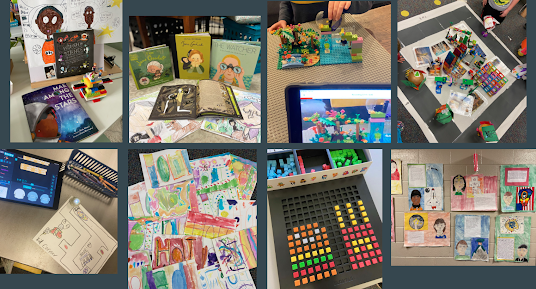
Have you been looking for ways to integrate art and creativity into literacy instruction? Look no further! There are many opportunities to engage in authentic learning experiences centered around art and focused on processes of making. The activities we (Amy & Emily) share in this article can be implemented in a wide variety of grade levels and can be connected to curriculum and content areas in a multitude of ways. Our hope is that you find something worth duplicating or sharing and feel empowered to begin creating in your own classrooms (or even at home)!


The response activities that we are going to share with you go beyond teacher-directed crafts and sometimes encourage the use of process art. First, let’s talk a little about what the term process art really means. Process art is a child-directed, choice-driven form of art that allows the artist to focus more on the process of what they are creating and not strictly the outcome or final product. This allows for a great amount of creativity and exploration and encourages socio-emotional skills by encouraging students to relax and not focus on a final product (which is very different from how they usually respond to literature). Responding with art also has an impact on problem-solving skills and planning, which relates directly to many other content areas.  


Below, we have highlighted some observations and conclusions we have made over our years of using art and STEM in our classrooms:


Why STEM?

  • STEM amplifies students’ learning

  • Encourages creative thinking and problem solving

  • Experimentation and trying new things teaches flexibility and adaptability

  • Allows for teamwork and collaboration

  • Builds resilience and determination as we learn that failing forward is okay (failing forward is a phrase used to describe learning from our mistakes)

  • Increases self-knowledge and understanding the perspectives of others

  • Many opportunities for cross-curricular connections

  • Great for vocabulary building and making real-life connections


Why Art?

  • Art allows students to explore, create, and express themselves

  • Process art lets students learn through artistic expression without worrying about a final product

  • Encourages risk-taking and inventiveness

  • Helps younger students with development of motor skills

  • Learning through visual art can make difficult concepts easier to understand

  • Art is a critical part of the engineering design process

  • Can be a unique launch for writing or reading response activities


Traditionally, we as teachers read a story and spend time allowing students to respond to open-ended questions or with a graphic organizer or a writing response journal entry. Instead, we challenge you to think about other ways that students can respond to literature using art or STEM. For example, after reading the story Jimi: Sounds like a Rainbow: A Story of the Young Jimi Hendrix by Gary Golio, primary students can respond in a variety of different ways. The story has many beautiful examples of figurative language, so students could find and illustrate figurative language used within the text.  


You could also take students on a musical journey by asking them to visualize what a certain genre of music sounds like and have them illustrate this emotion or build something that represents how the music makes them feel. Using art tools and building materials, students can express how the music makes them feel but more importantly, use their words to explain what they have created and why they created it. Talking about a creation is a vital part of the engineering design process and also helps students strengthen their critical thinking skills and storytelling abilities! 


Here are some of our favorite ways to incorporate the arts and STEM into literacy instruction:


Process Art: Using varying mediums, create a piece of art in response to a story (focus can be on theme, genre, plot, setting, mood, etc.)


Magazine and Paper Art: Using paper and/or magazines, create a collage of artifacts that relate to a certain story, character, setting, etc. Feeling ambitious? Try exploring further with paper folding, mathematical art or recreating a story with paper figurines!


For the Reluctant Artist: Use directed drawings or other art alternatives to inspire learners who might be more timid around art processes. This form of art is also great for biographies, character selfies, or creating comic strips to retell. 


Engineering Design: Using a variety of building materials, allow students to recreate or retell a story. This is a great alternative for younger students and further encourages the ability to retell a story or share cause and effect relationships! This can also be great for reluctant writers because creating a scene and talking about it can help inspire ideas or topics that can transfer into writing time.


Pixel Art: Using blocks, pegs or beads, students can create a pixelated image or symbol from the story. This pairs well with writing response and/or text-analysis because it gives learners the opportunity to explain the reasoning behind their creation. Feeling bold? Try experimenting with 3D pens or 3D printing to design and create this symbol instead!


Tech-Based Art: Learners can recreate scenes from stories or create their own story using tech tools and apps. This is great for exploring dialogue, retelling scenes or chapters, writing your own story and much more! Some of our favorite (& free) tech-based tools are:

  • ChatterPix Kids (app) - Allows you to take a picture of something (even something you’ve created) and make that object talk for up to 30 seconds. These creations can easily be saved and shared!

  • ScratchJr (app) - Allows you to recreate scenes and code characters using basic block coding (perfect for even the novice coder)

  • Stop Motion Studio (app) - Great for making short animations or recreating plots from stories with figurines or LEGO bricks.

  • Storyboard That  (website) - Digital storytelling and retelling by creating scenes and adding characters/props


We hope you have been inspired to include more art and STEM in your classroom! Additionally, here are some websites that you can explore for further creative ideas:

Friends Art Lab

The Artful Parent

Asia Citro’s 150+ Screen-Free Activities for Kids

TinkerLab

Teach Preschool

Storyboard That

The Book Wrangler

Art for Kids Hub

Tate Kids


With 8 years of experience as a school librarian, Amy Crider has a passion for using diverse literature in every content area! She is also a firm believer in the use of art for creative expression, learning, and mental health benefits. In her spare time, she enjoys reading and roller skating!


With 10 years of experience as classroom teacher and 3 years as a primary school STEM teacher, Emily Trace has explored many hands-on approaches to teaching STEM infused literacy. She is passionate about using engineering and robotics in the classroom to enhance everyday lessons. When she is not teaching, she loves to read and travel with her family!ces

Curriculum connect


Sunday, January 1, 2023

Writing Workshop Transformed My Classroom by Lauren Spang

 Writing Workshop Transformed My Classroom

by Lauren Spang


Shortly after I was hired as a first-year teacher at Rostraver Elementary School in the Belle Vernon Area School District, I made the promise to myself that I would give back to the students of my hometown school district by providing them with the best possible education they deserve – just like my favorite teachers did for me when I was a student at BVA. However, like most beginning teachers, I felt an overwhelming sense of frustration and uncertainty, specifically in the area of teaching writing at the upper elementary grade level, and I knew I needed something more to enhance my teaching as I embarked on teaching a new grade level and subject area. 


An elementary teacher is often considered to be a “jack of all trades” because it is essential to be knowledgeable in all elementary subject areas, as well as knowing the most effective and efficient methods of teaching certain specific content areas.  As a child, I knew that I always had a special knack for learning grammar, as its importance was frequently emphasized in my household growing up with my mother and grandparents who are now retired teachers. Even though I knew that I enjoyed grammar and was familiar with the content, I still felt very unsure about how to teach grammar and how to assist my students with the application of skills in their writing. Upon networking with many others, I realized we were all in the same boat: confused and uncertain, and willing to try anything beyond simply circling and underlining words in a sentence and calling that “grammar/writing” instruction for the day. 


During that first year of teaching, I attended every workshop regarding ELA instruction that I could possibly find, frequently crossing paths with my revered coworker, Carol Frow, an 8th grade teacher at BVA Middle School and the current Executive Director of WPCTE. At the time, Carol and I didn’t know each other well, but we quickly formed a like-minded partnership within our school district and began collaborating about how to better our writing instruction in our classrooms. We attended a few sessions through the Westmoreland Intermediate Unit 1 where we were introduced to a practice that “just made sense” to both of us. Val Piccini, a Reading Specialist and founder of the student Writing Project, Writers of Westmoreland, introduced the concept of Writing Workshop and how to implement mentor texts into our everyday ELA classrooms. Val referenced much of her research from the author, Lucy Calkins and Colleagues from TCRWP (Teachers College Reading and Writing Project), at Columbia University. More information regarding her curriculum can be found on the following website: www.unitsofstudy.com. When we learned of this practice, Carol and I were hooked: we fell in love with the idea of using a Writing Workshop in our classrooms. 


Over the years, I learned that the Writing Workshop structure of each lesson provides easy-to-follow scaffolding of higher-order thinking skills with minimal effort in lesson planning.  The Workshop Model was simple to implement because it was consistent and fit into my daily ELA schedule very nicely while juggling vocabulary and spelling instruction as well.  The initial implementation of the Writing Workshop completely transformed my classroom, and I was amazed at how positively my students responded to it.  Now, I have so much more confidence in myself as a writing teacher, and I thoroughly enjoy writing time because I know it is working. 


An overview of the workshop should look similar to the following structure: 

  • Mini-lesson (first 10-15 minutes of class): the teacher models the skill through whole-group instruction. (I usually incorporate Mentor Texts and Mentor Sentences into this portion of the lesson by intentionally selecting models of texts that teach a particular writing craft or skill.  I especially like to tie-in the grammar skill with my mini-lesson introduction.)  The teacher may follow each mini-lesson by providing the students with additional guided practice, but that is completely optional. (Personally, I like to give my students some additional assistance before they independently implement the strategies they learned.) Guided practice can also be completed in small writing groups for students who need the extra practice.  

  • Independent Writing/Conferencing (35-45 minutes): the bulk of the class period should be spent on Independent reading/writing while students have the opportunity to craft their writing.  During that time, I also conference with students individually or in small groups, and I encourage my students to peer conference with one another.  I typically provide them with peer conferencing checklists that give the students some autonomy while also holding them accountable to follow through with editing and revising one another’s writing.  If necessary, a mid-workshop reminder in the middle of the lesson may be modeled for a few minutes as well.  

  • Share (last few minutes of class): students have the opportunity to share and celebrate the work they have completed that day.


Author’s Bio: Lauren Spang is a fifth grade ELA teacher at Rostraver Elementary School in the Belle Vernon Area School District. She has been teaching fifth grade ELA for nine years at BVA, and she completed one year of teaching third grade in the Elizabeth Forward School District before landing her full-time position in her hometown: Belle Vernon Area. She received her B.S. in Elementary and Early Childhood Instruction from Saint Vincent College in 2012, and then completed her Masters Degree in Elementary Special Education from California University of Pennsylvania, now known as PennWest University. During the Summer of 2016, she attended the Summer Institute for Teachers hosted by the Western Pennsylvania Writing Project at the University of Pittsburgh Falk School under the direction of Laura Roop and the late CJ Coleman. Lauren is a teacher-consultant for the WPWP and an active promoter of Writing Instruction in the elementary classroom setting.


Thursday, December 1, 2022

Pursuing the Light at the 2022 NCTE Annual Convention by Amy Bouch & Carol Frow

Pursuing the Light at the 2022 NCTE Annual Convention

by Amy Bouch & Carol Frow


The 2022 NCTE Annual Convention theme was !Suenos! Pursuing the Light. We (Amy & Carol)  were able to pursue the light in so many ways—through collecting copies of books, chatting with authors, learning new ideas, networking with teachers across the country, representing our affiliate, and, of course, soaking in the southern California sun. 


The beauty of attending conferences is that it allows teachers to share ideas with other teachers. The beauty of writing this blog post is that it allows us to share those ideas with all of you. NCTE offers hundreds of sessions, so we are providing a quick list of some ideas that may be helpful to you.


Quick ideas to implement at any time:


  • Icebreaker / Community Building:

    • Talk for two minutes with a group to determine the most unique thing that everyone has in common.

    • Create a book cover as if the book was about the student’s life. Include an author bio, a blurb, and cover art.

    • Do gallery walks to share student work.


  • Writing:

    • Choose a topic (example: gratitude). Go to camera roll and choose a picture. Write about the picture and why it represents the topic.

    • Snowball fight - Write a line, crumple the page, throw it, open a new page, write another line, repeat.

    • Keep a list of information you Google to reference for topics to write about.

    • Write one stanza with a set format and then have students each write their own verse. Compile all of the stanzas into one writing piece.

    • Use picture books as mentor texts.

    • Review setting by writing a “Where I’m From” poem.

    • Celebrate writers. View Amy and Carol's presentation "Students in the Spotlight: Shining a Light on Students as Writers"


  • Reading:

    • Go to authors’ websites to see if they can virtually visit your class.

    • Character Analysis - create a body biography and then decorate the halls of your school with them. Although this link is not from who presented the idea, it gives a good example and visual images of the project.

    • Use the rich source of Indiginous writings to teach plot and culture at the same time.

    • Use verse novels with students if you aren’t already. More are published each year!

    • Include diverse authors in class; however, do not only focus on the tragedies. Show their triumphs or typical everyday experiences. A few great examples come from authors Lisa Yee, Kelly Yang, and Nic Stone.

    • Host a book tasting.


We encourage you all to pursue the light and make connections at the 2023 NCTE Annual Convention since it will be in Columbus, Ohio! We are very fortunate for the close proximity of next year’s convention.  Plan ahead to pursue your light and make connections with amazing educators from all around the world!  See you there!


Amy Bouch (pictured left) is a reading-obsessed 8th-grade English teacher at Chartiers Valley Middle School. She is the President of the Western Pennsylvania Council of Teachers of English (WPCTE) and a Teacher-Leader for the Western Pennsylvania Writing Project (WPWP). Amy is also the 2022 Grammar Teacher of the Year and currently serving on the NCTE Middle Level Section Nominating Committee. When she isn’t teaching, she is making her way through all of the U.S. National Parks and traveling the world with her husband. Connect with her at abouch@cvsd.net.


Carol Frow (pictured right) is a middle school educator of thirty-four years.  Currently teaching reading 7 and 8 as well as an advanced English 8 course, Carol also runs the drama, musical, literary magazine, and guides various reading competition teams at Belle Vernon Area Middle School.  She is the Executive Director of WPCTE, past WPCTE president and Executive Board Member, and is a Teacher-Consultant for the WPWP.  In addition, Carol is a member of PAECT, a 2021 KTI Star, and a member of  NSTOY - PA, where she was a 2014 finalist for the PA Teacher of the Year, is currently a TEACH mini-conference presenter, and a TEACH mentor.  Carol has been published in English Journal in November 2017 for her article, “Give Sorrow Words: A Lesson Learned”, which was co-written with a former student and has an upcoming publication in the book 8th Grade Ready, for the chapter  “Chapter Three: A Deeper Dive into Course Selection” ( forthcoming - June 2023).  In her spare time, Carol, like Amy,  enjoys traveling through national parks.  She spends her time with author-named felines and reads continuously!  Connect with Carol at Carol.AtenFrow@bvasd.net.


A Nightmare on ELA Street: Designing a Horror Lit Elective by Jason M. Kosmiski

 A Nightmare on ELA Street: Designing a Horror Lit Elective by Jason M. Kosmiski, WPCTE Secretary Last year, R.L. Stine spoke at the PennWe...