2022 MG/YA Book Recommendations Month-by-Month (Part 1)
by Lesley Roessing
When invited to write a blog about MG/YA books that I may recommend to read through the year, I immediately thought about suggesting books to read in book clubs, 5-6 recently-published novels/memoirs of different reading and interest levels, featuring culturally diverse authors or characters and settings, written in a variety of formats—prose, verse, graphic, or multi-formatted. Even though in my own classroom I taught a gradual-release-of-responsibility model, employing one whole-class novel, then a few book club novels, scaffolding to self-selected choice novels, I strongly advocate for book clubs whenever possible.
BOOK CLUBS offer countless advantages:
• social
• supportive—readers can read more complex text with support of peers
• deeper discussions—with more participation and multiple perspectives and a safe space for those important conversations
• collaboration—to learn and practice social skills necessary in the real world
• increased reading and employment of skills–-reading required to participate
• motivation to read—to participate in club discussions and activities; peer pressure
• a way to meet listening and speaking standards
• differentiation—class can read at multiple reading levels; students can read at individual reading and interest levels
• choice—students can choose books of interest = motivation
• provide a small safe community to discuss sensitive issues
• a class can read multiple formats at the same time: prose, verse novels, graphic novels, or multiple topics/titles within a genre or format
• readers learn about 4-5 other novels; after-reading Book Club presentations introduce books to entire class
Therefore, I will suggest 4-6 novels for each month that can be combined for class book club selections or employed as whole-class or independent, self-selected reading choices. Summaries of these novels are available on Goodreads, and my review of many are available on my Goodreads account (https://www.goodreads.com/user/show/46246977-lesley) or my Facebook Page (https://www.facebook.com/lesley.roessing) under #TalkingTexts.
For strategies for planning, organizing, facilitating, teaching discussion practices and literacy lessons, and assessing book clubs and for more suggestions for reading books based on common topics, genres, formats, characters, settings, and authors, as well as other types of text clubs, such as Memoir Clubs, Nonfiction Clubs, Short Story Clubs, Article Clubs, Poetry Clubs, and Textbook Clubs, see Talking Texts: A Teachers’ Guide to Book Clubs Across the Curriculum (2019), a WPCTE Book Club selection in October 2020.
* * *
JANUARY: Family Month The beginning of the new year when students are headed back to school after time spent with all different types of families would be an effective time to read and talk about the many types of families.

Some novels I would suggest for Middle Grades:
K.A. Holt’s verse novel* House Arrest
Lynda Mullay Hunt’s One for the Murphys
Before the Ever After, a verse novel* by Jacqueline Woodson
Another novel-in-verse*, A.L. Sonnichsen’s Red Butterfly
Two Naomis (and the sequel Naomis Too) by Olugbenisola Rhuday-Perkovich
The Dollar Kids by Jenifer Richard Jacobsen
Some novels I would suggest for High School:
Far from the Tree, by Robin Benway, winner of the 2017 National Book Award for Young People’s Literature
Natasha Friend’s The Other F Word (F for Family)
One, a verse novel* written by Sarah Crossan
Clap When You Land, a verse novel* by Elizabeth Acevedo
Skyscraping, a verse novel* by Cordelia Jensen
FEBRUARY: In honor of Black History Month
Some novels/memoirs I would suggest for Middle Grades:
Jewell Parker Rhodes’ Ghost Boys
A Long Way Gone: Memoirs of a Boy Soldier, a memoir written by Ishmael Beah
Unbound, a historical fiction in verse* by Ann E. Burg
The Parker Inheritance by Varian Johnson
The Long Ride by Marina Budhos
Some novels/memoirs I would recommend for High School:
X, written by Malcom X’s daughter Ilyasah Shabazz and Kekla Magoon
American Ace, a novel in verse* by poet Marilyn Nelson
Kaffir Boy, Mark Mathabane’s memoir
Taking Flight: From War Orphan to Star Ballerina, Michaela DePrince’s memoir
Turning 15 on the Road to Freedom: My Story of the Selma Voting Rights March, a memoir by Lynda Blackmon Lowery
Loving vs Virginia, a verse* documentary by Patricia Hruby Powell
FEBRUARY: In honor of the NCTE National African American Read-In
Some novels I would suggest for Middle Grade readers:
Jewell Parker Rhodes’ Black Brother Black Brother
Full Cicada Moon, a verse novel* by Marilyn Hilton
The Season of Styx Malone by Kekla Magoon
A Comb of Wishes by Lisa Stringfellow
Blended by Sharon M. Draper
Nic Stone’s newest novel, Fast Pitch
Some novels I would suggest for High School:
All American Boys written from two perspectives by Jason Reynolds and Brendan Kiely
The Skin I’m In and The Life I’m In, two novels by Sharon Flake
Tiffany Jackson’s provocative novel Allegedly
How It Went Down by Kekla Magoon
Kwame Alexander’s free verse* Solo
MARCH: Women’s History Month:

Some novels I would suggest for Middle Grades about actual historic events, but featuring fictitious characters:
Words on Fire by Jennifer Nielsen
A Night Divided also by Jennifer Nielsen
Ann E. Burg’s verse novel* Unbound
Fever 1793 by Laurie Halse Anderson
The Last Cherry Blossom, written by Kathleen Burkinshaw and based on her mother’s life
Some novels about actual women in history I would recommend for High School:
Loving vs Virginia, written in verse* by Patricia Hruby
Audacity another free verse* text by Melanie Crowder
Turning 15 on the Road to Freedom, a memoir by Lynda Blackmon Lowery
Rima’s Rebellion: Courage in a Time of Tyranny also a verse novel* by Margarita Engle, a Cuban-American author and 2017-2019 Young People’s Poet Laureate
Margarita Engle’s The Lightning Dreamer: Cuba’s Greatest Abolitionist
MARCH 2: Read Across America Day
Suggestion 1: School librarians or classroom ELA teachers could set up a United States wall map, and students could place tacks or pins at the site of the setting(s) of novels they have finished reading, either the last novel they read or the novels they read from March 2 to the end of the year. World Lit teachers could display a world map with the same assignment.
Suggestion 2: Book Clubs: Each Book Club across the grade level could read a novel that takes place in a different state, or within a class, each Book Club could read a novel from a different section of the country: Northeast, Northwest, Southeast, Southwest, Central. Book Clubs could present their book and how it reflects the part of the country in which it takes place. Some examples might be
Northwest—The Honest Truth (Washington) by Dan Gemeinhart
Southwest—Bernice Buttman, Model Citizen (Texas) by Niki Lenz
Northeast—A Home for Goddesses and Dogs (Connecticut) by Leslie Conner
Southeast—The Paris Project (Florida) by Donna Gephart
Central—Smack Dab in the Middle of Maybe (Mississippi) by Jo Hackl

APRIL: National Poetry Month: Books in Verse

Verse novels are novels written in free verse; in other types of verse, such as Nikki Grimes’ Garvey’s Choice written in tanka; or in variety of verse types, as in Laura Shovan The Last Fifth Grade of Emerson Elementary. Novels-in-verse can be multi-formatted, employing a fusion of different types of verse, prose, and graphics. In some verse novels, there are two narrators, one writing in verse and one in prose, in some cases written by two co-authors; some verse novels offer multiple narrators and perspectives.
Novel-in-verse is a text format which engages readers for divergent reasons. Reluctant readers, emerging readers, and ELL readers particularly appreciate the less-dense text while proficient readers value their lyricism and creative structures, the words, the spacing—sometimes creatively designed.
Verse “novels” are published in a variety of genres, i.e., memoir, biography, historical fiction, and all other types of fiction, and written at a range of reading levels. These novels are available by culturally-diverse authors on diverse topics, featuring diverse characters and settings. Verse texts lend themselves to lessons for teaching poetic elements and devices and can be employed as mentor texts for writing poetry or poetically.
*Some verse novels are included in the previous and subsequent months’ listings and over 100 are reviewed in http://www.yawednesday.com/weekly-posts/verse-novels-to-engage-readers-an-update-on-20-new-novels-in-verse-by-lesley-roessing and the previous guest-blogs which are linked within.
Some novels-in-verse I would suggest for Middle Grades:
Above the Rim, as well as all other Jen F, Bryant verse biographies and novels for both MG and YA readers
Starfish by Lisa Fipps
Three Pennies by Melanie Crowder
House Arrest and other novels by K.A. Holt
Crossover, Rebound, and Booked by Kwame Alexander
Some YA verse novels I would suggest for High School:
Long Way Down by Jason Reynolds
Junk Boy by Tony Abbott
The Poet X, as well as other novels by Elizabeth Acevedo
White Rose, a historical fiction verse novel by Kip Wilson
Saving Red and other novels by Sonya Sones
Up from the Sea by Leza Lowitz
MAY: Asian Pacific American Heritage and Jewish American Heritage Month
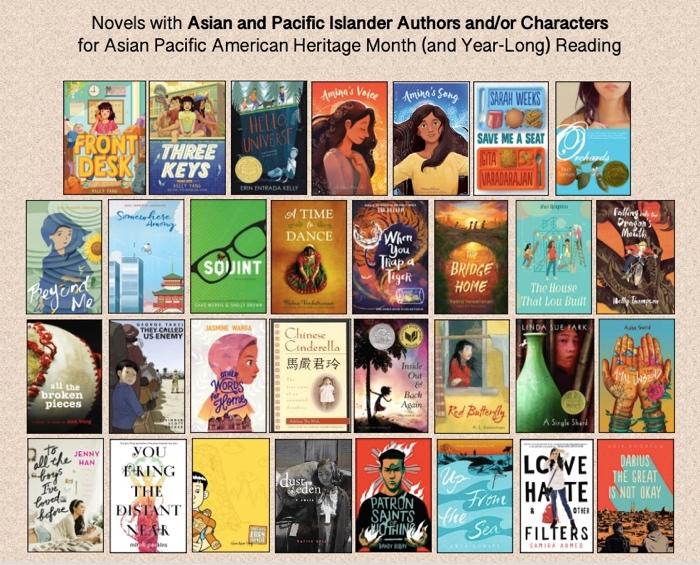
Some novels I would suggest with characters of Asian Pacific American heritage for Middle Grade readers:
Front Desk and its sequel, Three Keys by Kelly Yang
The Called Us Enemy, a graphic novel by George Takei
The Bridge Home by Padma Venkatraman
Into the Tiger’s Mouth, a verse novel, by Holly Thompson
When You Trap a Tiger, winner of the 2021 Newbery Award, written by Tae Keller
Some novels with Asian Pacific American heritage I would suggest for High School readers:
Patron Saints of Nothing by Randy Ribay
Up from the Sea, a verse novel by Leza Lowitz
American Born Chinese, a graphic novel written and illustrated by Gene Luen Yang
Love, Hate, and Other Filters by Samira Ahmed
You Bring the Distant Near written by Mitali Perkins
Some Middle Grade novels that include Jewish customs, holidays, and traditions, a few which also include characters of Asian or Pacific American heritage*:
Falling Over Sideways by Jordan Sonnenblick
*A Place at the Table by Laura Shovan and Saadia Faruqi
Get a Grip, Vivy Cohen by Sarah Kapit
*The Magical Imperfect by Chris Baron
*Not Your All-American Girl by Madelyn Rosenberg and Wendy Wan-Long Shang
*My Basmati Bat Mitzvah written by Paula J. Freedman
Coming of Age: 13 B’nai Mitzvah Stories, edited by Jonathan Rosen and Henry Herz
JUNE: LGBTQ+ Pride Month
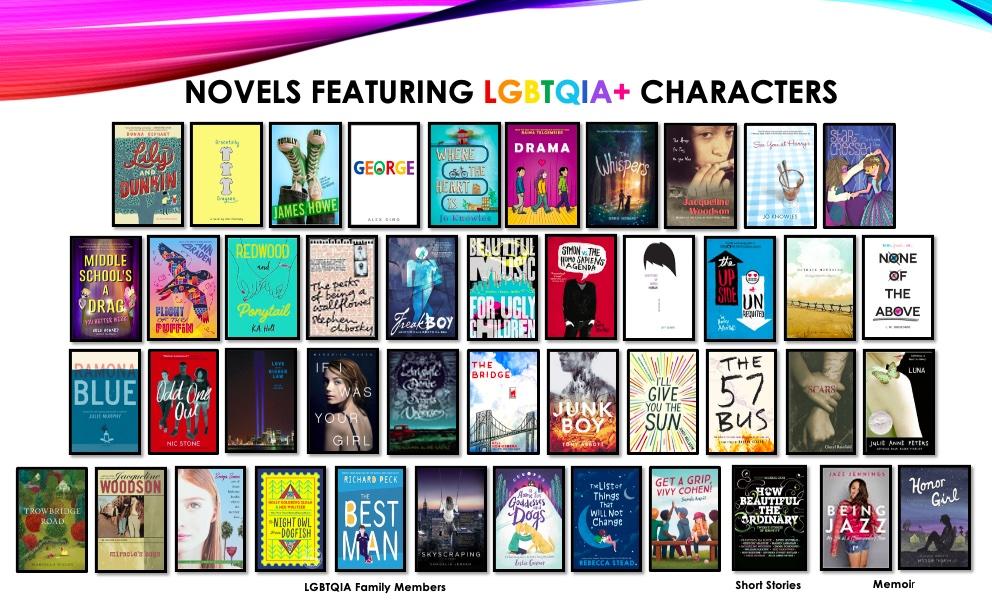
Some novels I would suggest for Middle Grade readers are:
Lily and Dunkin by Donna Gephart
Drama, a graphic novel, by Raina Telgemeier
Greg Howard’s Middle School’s a Drag
Flight of the Puffin, a multi-formatted novel by Anne Braden
Gracefully Grayson by Ami Polonsky
Trowbridge Road by Marcella Pixley
Some novels I would suggest for High School readers are:
If I Was Your Girl by Meredith Russo
Honor Girl, a graphic memoir by Maggie Thrash
The Bridge written by Bill Konigsberg
October Mourning: A Song for Matthew Shepard written in multi-formatted verse by Leslea Newman
Skyscraping a verse novel* by Cordelia Jensen
Later this year, I will blog about MG/YA suggestions for July-December 2022.
* * *
A middle school and high school teacher for twenty years, Lesley Roessing was the Founding Director of the Coastal Savannah Writing Project at Georgia Southern University (formerly Armstrong State University) where she was also a Senior Lecturer in the College of Education. In 2018-19 she served as a Literacy Consultant with a K-8 school. Lesley served as past editor of Connections, the award-winning journal of the Georgia Council of Teachers of English. As a columnist for AMLE Magazine, she shared before, during, and after-reading response strategies across the curriculum through ten “Writing to Learn” columns. She now works independently, writing, providing professional development in literacy to schools, and visiting classrooms to facilitate reading and writing lessons. Lesley is the author of


