Wednesday, May 1, 2024
"Won't You Be My Neighbor?": Fostering Connection through Mister Rogers' Legacy By: Sarah Wilt
Monday, April 1, 2024
Guide Your Students in Writing a Personal Statement Essay for College Admission and Self-Reflection By: Alyx Matchett
Guide Your Students in Writing a Personal Statement Essay for College Admission and Self-Reflection
By: Alyx Matchett
The college essay or personal statement, akin to a semi-formal rite of passage, has become a valuable tool in self-discovery for my students, even for those who choose not to apply to college during 12th grade. No matter their post-secondary pathway, we must empower students with the skills they need to navigate uncertainty, make informed decisions, and contribute meaningfully to their communities. It’s not just about crafting a compelling essay or choosing a major; it’s about the transformative impact of providing students the time and space to reflect on what they care about and why it matters.
Just as classroom teachers strive to understand and connect with each student in their classroom, colleges aim to uncover the essence of their applicants through this critical piece of writing. While transcripts, test scores, recommendations, and activity lists present a snapshot of academic merit and focus, this essay serves as a beacon for colleges and universities, especially the highly selective ones. With an approximate length of 650 words, the personal statement is more than just a piece of writing; it's an introduction to the experiences, moments, and insights that have shaped the students into the individuals they are today.
Before we delve into guiding your students through the essential elements of their personal statements, let's clarify a few things the essay is not, courtesy of College Essay Guy:
- It's not a typical five-paragraph English class essay with an introduction, argumentative thesis, three body paragraphs, and a conclusion.
- It's not a mere recitation of their resumes.
- It's more than a journal entry, although some structural elements might share similarities.
- And most importantly, it's not an academic essay where students shy away from the personal pronoun "I."
Now that we've established the significance of the personal statement, let's dive into the intricacies of what to include. In guiding your students, it is important for them to understand how this essay showcases the skills, qualities, values, and interests that they will bring to a college campus (and the world at large!). This can be achieved through recounting moments, sharing stories, and reflecting on experiences that have shaped their values, with the exercises linked below.
Step 1: Brainstorming through Identifying Values and Relatable Experiences
Despite students having the benefit of writing about themselves, students will struggle without guidance. Since the goal is to reflect on one’s personal values, I suggest students begin with the Values Exercise.
Once values are identified, students need some self-discovery to determine how those values were formed. Here is a list of activities that help students find key moments in their lives that students can then connect to their identified values:
- Essence Objects Exercise: Encourage students to brainstorm around objects that hold significance in their lives. These objects can serve as tangible representations of their values, providing material for a compelling story.
- 21 Details Exercise: Guide students to list 21 specific details about themselves. This exercise prompts them to delve into both significant and seemingly trivial aspects of their lives, fostering a rich pool of potential content for their essays.
- 7 Short Brainstorming Exercises: If my students are struggling to find a topic, I will often direct them to this video with 7 more exercises to do on their own. These exercises cover everything from identity to careers to interests to extracurricular activities.
The goal of this step is to encourage reflection on personal experiences, values, and aspirations, ensuring that their essays are not only compelling but also authentic expressions of who they are. Students may want to include career or academic goals, or conversely, be worried about their uncertainty in this regard. When addressing academic and career goals with my students, I clarify that including these goals are optional and colleges recognize students may still be exploring their paths.
Step 2: Choose a Text Structure and Start Drafting
In structuring the personal statement essay, I will suggest two main types: montage and narrative structure.
Montage Structure is a series of experiences and insights connected by a thematic thread. Through this model, you might encourage students to consider exploring different facets of their identity through this approach, such as recounting experiences from various "homes" that reveal different sides of who they are.
Montage Draft Outline Checklist
Does my montage outline include:
- A topic or theme that is clear? Or is it kind of vague?
- Specific examples in each paragraph? Do they clearly connect to the topic?
- Values?
- Insights (aka “so what” moments)?
Narrative Structure, similar to classic Western story structure, with a focus on Challenges Faced, Actions Taken, and Lessons Learned. If a student is considering discussing challenges that they have faced, this shows a chronological retelling of how they resolved a problem in their lives.
Narrative Draft Outline Checklist
Does my narrative outline include:
- The challenges you faced?
- The effects of the challenges were on you?
- What you did to overcome your challenges?
- What you learned through these experiences?
These are the most common text structures used in college admissions essays. Students could certainly get creative in their structure by combining montage & narrative, or by using a different approach entirely.
Step 3: Offer Feedback like a College Admissions Advisor
Focus on the importance of college-level writing skills such as clear articulation of ideas, strong text organization, adherence to the 650-word limit, and proofreading once the drafting is done.
Ask questions that help students showcase their core values. The finished piece should show the reader what kind of person they are. Encourage students to seek feedback from peers, other teachers, and/or counselors.
The college admissions essay process is a journey of self-discovery and expression, offering students the opportunity to reflect on their past, present, and future aspirations. By guiding them through each step with patience, encouragement, and strategic support, English teachers play a pivotal role in empowering students to articulate their stories authentically and compellingly. As they embark on this transformative endeavor, remind them that their voices matter, and their narratives have the power to resonate profoundly with admissions committees. With diligence, reflection, and resilience, students can craft personal statements that not only stand out amidst the sea of applications but also illuminate their unique identities and potential for academic and personal growth.
Here are a few more resources that may help you along the way:
- College Application Resource Hub
- Personal Statement Examples
- The Great College Essay Test
- Revising Your College Essay in 5 Simple Steps
- How to Brainstorm 7 Different Personal Statement Ideas
- Podcast Episode: A Crash Course on the Personal Statement
- Why You Don’t Have to Write about Trauma in Your College Essay to Stand Out—and What You Can Do Instead
- Is It “Okay” to Talk About Race in Your College Application and Essays—And If So, How Should You Do It
Friday, March 1, 2024
"Embracing the Legacy of Mister Rogers: Fostering Kindness in the Classroom" by Dr. Jennifer L. Toney & Ms. Tracy L. Andrews
"Embracing the Legacy of Mister Rogers: Fostering Kindness in the Classroom"
By: Dr. Jennifer L. Toney & Ms. Tracy L. Andrews
In 2022, we had the privilege of meeting Gregg Behr, co-author, along with Ryan Rydzewski, of When You Wonder, You’re Learning, during his keynote address at the Pennsylvania Educational Technology Expo and Conference (PETE&C). His words ignited a spark within us, prompting a deeper dive into Fred Rogers' renowned learning principles. Recognizing the profound intentionality behind Mister Rogers’ work, we felt compelled to integrate the Fred Method into our educational practices.
As we further explored Fred's legacy, his gentle demeanor and profound insights on kindness resonated deeply with us. As elementary educators dedicated to nurturing kindness and empathy in our students, we embraced the opportunity to reflect on Mister Rogers' enduring influence and its impact on our teaching philosophies. In this blog post, we are excited to share insights, activities, and resources that have played a pivotal role in fostering kindness within our classrooms and communities.
Fostering Kindness in Third Grade: Jen's Insights, Activities, and Resources
Fred Rogers famously said, "There are three ways to ultimate success: The first way is to be kind. The second way is to be kind. The third way is to be kind." The message Fred conveyed remains as relevant today as when he first spoke those words. As educators, we bear the responsibility not only to prepare our learners academically but also to help them develop strong character. At Sharpsville Area Elementary School, our schoolwide positive behavior program offers a framework that fosters and rewards acts of kindness among students and staff. I draw on these school community goals as I engage with my third-grade writers daily and use them as a springboard to model and promote kindness in our classroom community. I prioritize community building at the onset and throughout the school year, recognizing that it's the personal connections and interactions that truly underpin a thriving classroom community.
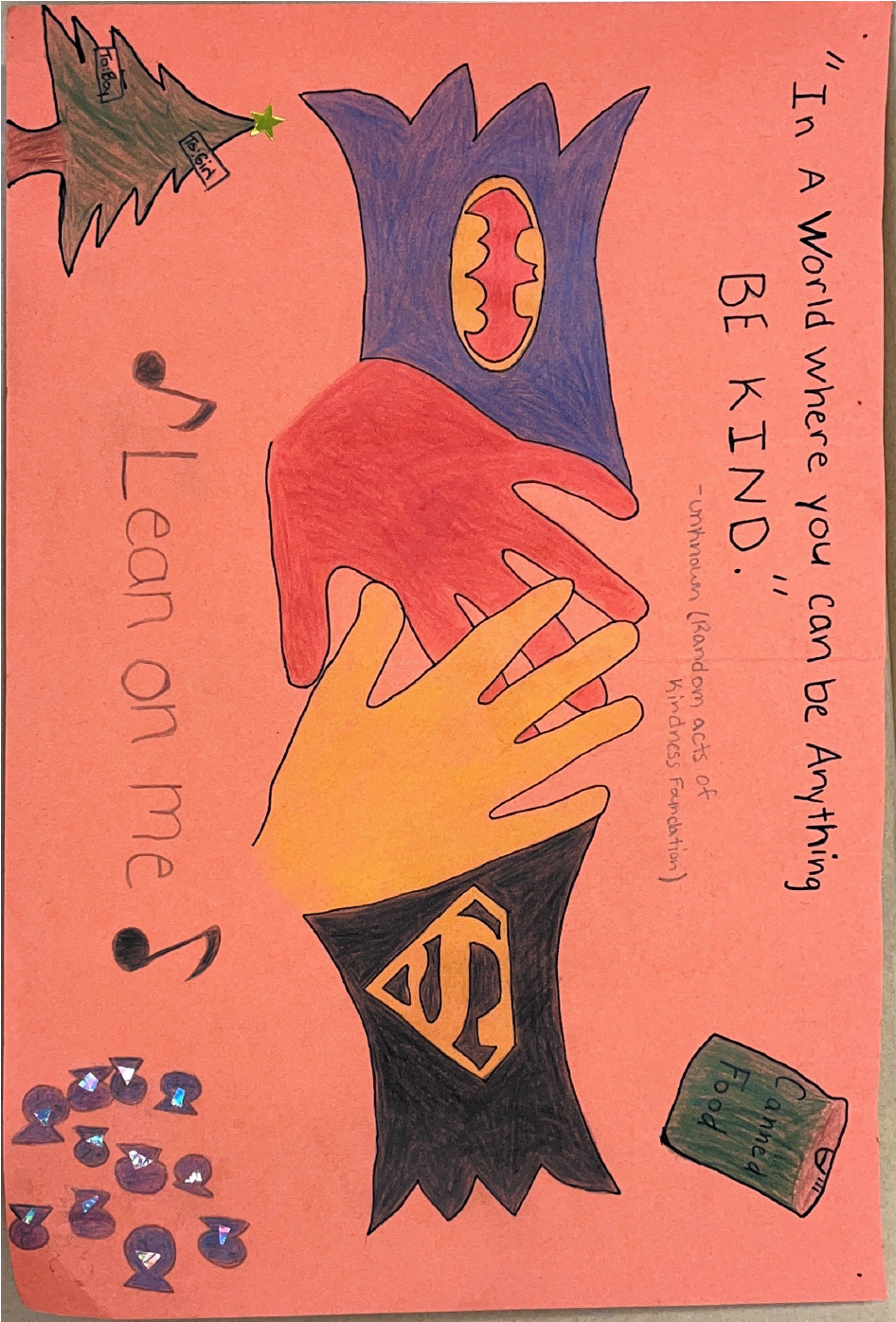
To foster kindness and connection, I kick off the school year with a collaborative project called the Curation Quest. This project was inspired by William Kist’s book, Curating a Literacy Life: Student-Centered Learning with Digital Media. We gather various multimodal artifacts, including books, films, songs, quotes, artworks, and hands-on experiences, all centered around a specific theme. This year, we focused on developing a growth mindset, setting the stage for exploring kindness, courage, and gratitude throughout the year. Together, we explored and discussed meaningful artifacts, getting to know each other better in the process. We then used our findings to create a remix poster and reflections that highlighted the impact of our quest. Afterward, students embark on their kindness quests, seeking out acts of kindness in their daily lives. They compiled their findings into colorful posters, which we proudly displayed on a kindness wall. It was heartwarming to see their excitement as they shared their discoveries and the impact they have had on the world around them.
Kindness Remix Poster Example
Nurturing Kindness in First Grade: Tracy’s Insights, Activities, and Resources
At the start of every year, I imagine my classroom transformed into a Neighborhood of Make-Believe, buzzing with kindness inspired by Fred Rogers. To achieve this I must be intentional in my actions. Every interaction with my students becomes a chance to practice his philosophy, embodied in the quote, "Treat our neighbor as we would hope to be treated." Instead of harsh corrections, mistakes become opportunities for empathy and learning. When a student struggles, I kneel, hoping to mirror Mister Rogers' gentle eye contact, and ask, "How can I help you today?" As a result, mistakes don't define our classroom – instead, they spark a desire to help one another.
By encouraging "helpers" in the classroom, students learn about the joy of helping others. Group projects unfold with modeling of "I like what you're thinking" affirmations, turning competition into collaboration. Celebrating individual differences happens daily, fostering acceptance and belonging. By reading books like How Full is Your Bucket, The Color of US, My Mouth is A Volcano, We’re All Wonders, Leo the Late Bloomer, Alexander and the Terrible, Horrible, No Good, Very Bad Day, Unicorns Don’t Love Rainbows, and many more that honor our individuality, I hope that my students internalize the message of kindness and acceptance, carrying it beyond the classroom walls. Remember, Mister Rogers didn't just talk about kindness; he lived it. His methods invite all educators to do the same – to create a space where kindness flourishes, one neighborly act at a time. Striving to be an example of the kindness he taught is the best way I know to teach my students to do the same.
Fred Rogers has left an enduring legacy of kindness on the world. His intentional work has inspired us, along with many others to invite his blueprint into our classrooms and communities. If you are interested in learning more about Fred and his legacy, we invite you to attend the 2nd annual frED camp on Saturday, March 23, 2024, at Ehrman Crest Elementary School in the Seneca Valley School District. It’s a special opportunity for educators to not only earn free Act 48 or PQAS credits, but also a chance to connect with all sorts of local professional learning opportunities, and ground their work in the lessons left to us by Western PA’s own Mister Rogers. Register today at: bit.ly/frEDcamp24. We hope you can join us for a beautiful day in the neighborhood!
Biographies:
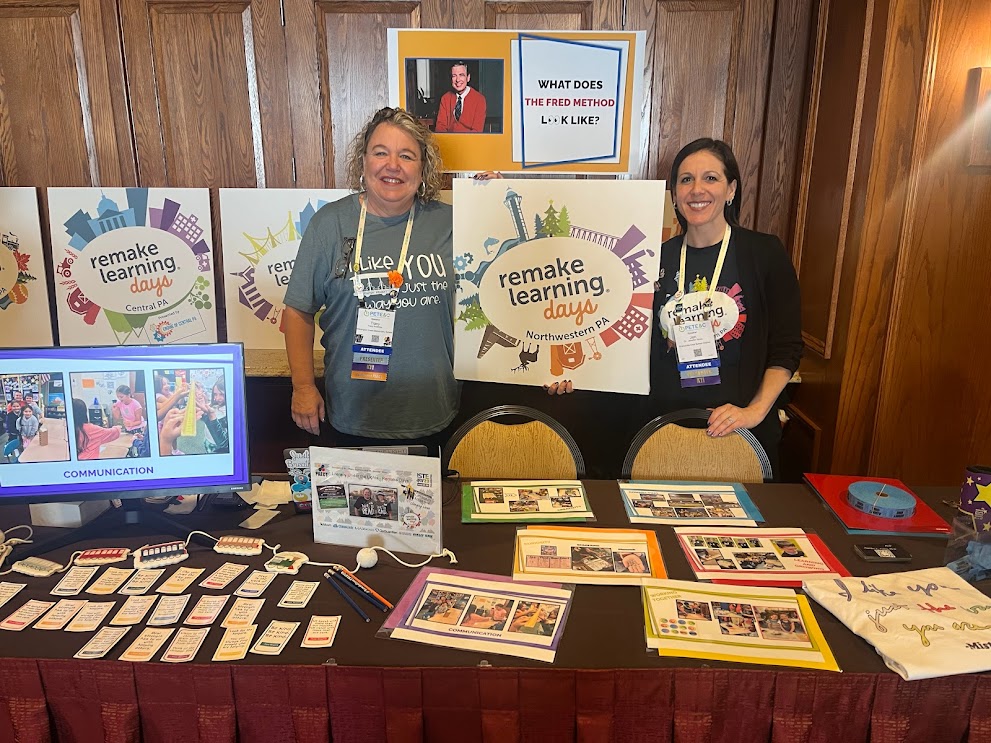
Tracy (left) and Jen (right) presenting their poster session “Teach Like Fred” at the Pennsylvania Educational Technology Expo & Conference (PETE&C) last month.
Jen is an eighteen-year veteran elementary educator and currently teaches third graders in a departmentalized ELA classroom at the Sharpsville Area School District in Sharpsville, PA.
Tracy has been working with children from birth to 6th grade for more than 35 years. Currently, she is teaching first grade at the Wilmington Area School District in New Wilmington, PA.
Thursday, February 1, 2024
Painted Reflections: Using Watercolor Painting to Splash in Some Deep Thinking By Danielle Brody
Painted Reflections: Using Watercolor Painting to Splash in Some Deep ThinkingBy Danielle Brody
I teach middle school, so keeping my students engaged and focused on the content can require some sparkle and pizzazz. Getting my students to think deeply about their reading can feel inauthentic or frustrating. I need tools ready to go that I can count on to be painless yet challenging, rigorous yet engaging, creative yet tangible. One of the many tools in my metaphorical teaching toolbelt is something I call painted reflections. I first discovered the painted reflections at a virtual conference hosted by Harvard’s Project Zero which focused on engaging students. Something about this presentation spoke to me. I fell in love instantly. I got excited about something that usually made me nervous: art.
The concept is simple. Students use watercolor paints to represent abstract concepts in their reading and then write about their work and its connection to the text. Painted reflections allow students to express what they know without getting bogged down in the complexities of writing. Using art allows students of all levels to express their understanding in a low-stakes way. Here’s how to make it happen in your classroom.
Materials:
- Watercolor Paints
- Paintbrushes
- Watercolor Paper
- Spray Bottle (optional)
- Water Cups
- Paper towels
- Clean Up Supplies
Step 1: Pick a Prompt
Construct a prompt that is open-ended enough to allow for a deeper understanding of the text and individual responses. Here are some examples of prompts I’ve used in my 8th and 9th grade ELA classrooms:- Represent one of the themes of “The Most Dangerous Game” through art.
- Represent the mood of “The Cask of Amontillado.”
- Capture the emotions in Act I, Scene 5 of Romeo and Juliet where the two first meet.
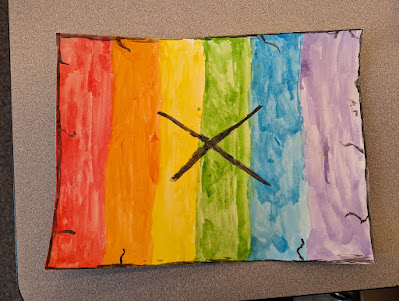
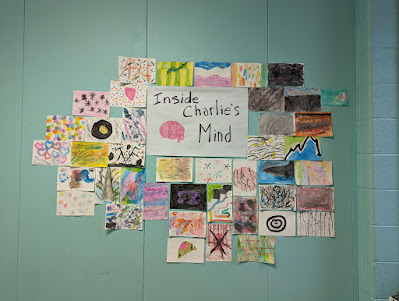
- Choose a scene from Flowers from Algernon and represent the inside of Charlie’s brain during the events of that scene.
Step 2: Prepare the Students
The first time I use this strategy with my students, I always make sure to give them small “practice” page and ask them to play with how to use the paints. Experiment with wet on wet, wet on dry, using different pressures and angles with the brush, etc. This video can help illustrate one way to go about instructing your students about how to begin with watercolors. Remember, you can’t mess it up.Talk about color symbolism. “What color would you use to show anger? joy? hope? What impression would you get from a person if they were dressed all in black? bright pink? pale yellow?”
Talk about textures and lines. “What kind of line would you draw if you were furious? silly? happy?”
Talk about symbolism. “What could a heart represent? a mountain? the sun?”
Talk about abstract art. I usually show a more obvious representaion and an abstract representation of a field of flowers. I make sure to note how abstract is all about the “vibes.” This usually helps them understand. I also make note of how artists use the entire canvas and encourage students to do the same.
Step 3: Dig into Painting
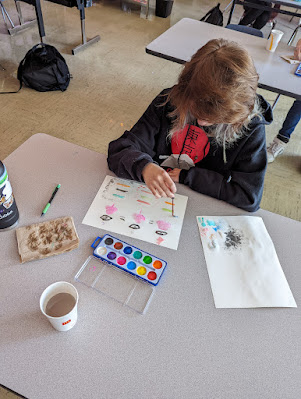
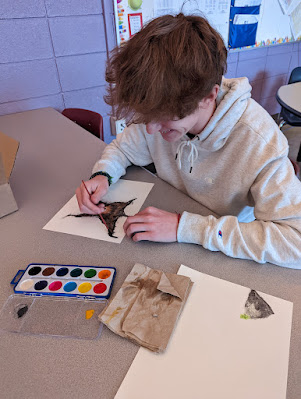
Now it’s time for the fun part! Let your students paint. I usually give them half sheets of watercolor paper about 5” x 7”.You will be amazed at how quiet and focused your students will be. Have fun watching their creativity blossom.
I give them some time the next day to allow for drying in case they want to do some work with layers. Don’t forget to make a physical space for their paintings to dry without being stacked.
Step 4: Respond to the Prompt
The next day, I have the students write on the back of their paintings to explain their work. This is where students can demonstrate their understanding. I’m often very impressed with their thinking and connections. I use the SLAM writing structure in my class, but you can adapt it to fit your strategies or classroom needs. If your students are struggling, provide them with scaffolding questions:- Why did you choose those certain colors/textures?
- What are you trying to represent with your art?
- How does your art connect to the text we read?
Step 5: Share the Art
Art is meant to be shared and appreciated. There are many different ways you can make this happen. Here are just a few examples:- Gallery Walk
- Artist Hot Seat
- Small Group Sharing
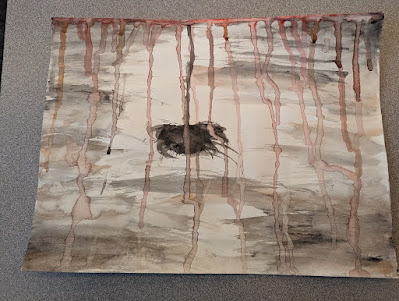
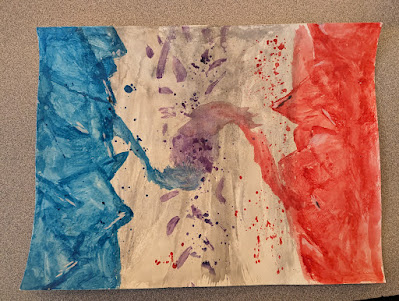
Eighth-grade reading students reflect on the inner thoughts of Charlie from Flowers for Algernon.
I promise that your students will be begging for painted reflections every time you read a new text. Remember, you and your students don’t need to be skilled artists to create meaningful art. Author Rainbow Rowell said it best, “Art wasn’t supposed to look nice; it was supposed to make you feel something.”
Monday, January 1, 2024
A New Year's Wish by Carol Frow
A New Year’s Wish
by Carol Frow
Whenever someone asked me for a book recommendation, I used to take pride in being able to answer with both excitement and knowledgeable authority. Please notice the words “used to.”
Of course I am a reader. I teach ELA! Not only do I sink my teeth into the latest mysteries by Janet Evanovich and Robert Parker, but lately, a book club of close friends I initiated is reading those titles we’ve wanted to get to but never did. Those are a joy! But, as an ELA teacher like many of you readers, time is limited, so mostly I read the books my students read so as to build a reading environment in my classroom, converse with students about books, and even make recommendations to those who claim to not be readers. After a few questions such as genre, type of protagonist, and topic/theme, I can usually steer these tenuous readers to something that they could potentially enjoy.
So, why “used to”?
“It’s too violent!” Meanwhile, do these students play video games where killing is the goal?
“It’s got offensive words in it.” Meanwhile, have these students heard (and said) worse on the bus that very morning (or perhaps in their living rooms at home or online…)?
“It’s immoral with too much sexual content.” Meanwhile, do these students have access to HBO, Cinemax, etc. as well unlimited access to TikTok and YouTube?
“It has content I don’t agree with.” Meanwhile, do they tout themselves as moral people who supposedly teach acceptance and tolerance?
I recall a common adage most people used to adhere to – treat others as you would want to be treated.
Or better yet, when I taught in a Catholic school, the third grade religion text defined “Catholic” as “open to the whole world.”
Open. Perhaps I can extend that to the concept of being open-minded. I strongly believe that people are entitled to their opinions and beliefs. I would not want someone condemning my opinions or beliefs; however, where is the discussion and debate? Where is the open-mindedness to simply hear someone’s thoughts and make a conscientious effort to think differently or step out of one’s comfort zone to understand someone else’s ideas? What happened to some study or research before forming an opinion?
What happened to actually reading the entire book before condemning it?
I used to truly love recommending books to people, but I don’t enjoy having to add disclaimers to potential readers. It could be more violent than you prefer. It could have some words that might upset you. It might make you uncomfortable…. It might contain ideas that are different from yours….
What happened to opening the cover of a book and desiring to enter into a world that was different from your own? What happened to reading a book to learn about new things? To go to new places? To discover aspects of culture? To realize that even though there may be differences in ideals or life choices that deep down inside, people are just people?
What happened to discussing a book to learn the incredibly important themes within it, those themes which will diminish the violent scene, the discomfort, the offensive concept, and potentially promote love, understanding, and acceptance? Wouldn’t that far outweigh the page, or scene, sentence or line, even the single word that some people “heard” about this book to deem it unacceptable?
So, what is my new year’s wish for this brand new year? I truly hope that before more books are condemned and banned, before more books are yanked from library shelves, before more teachers are forced to dismantle their classroom libraries, and before more students lose the love of reading books they choose, that people would actually read the book, absorb those words from the page, ponder their relevance, and allow the lesson to outweigh the sudden spurious suspicions that fuel the bandwagon.
Happy New Year, WPCTE Members! May you all have a wonderful second half of the school year, and may it be filled with wonder in the classroom, good books for all to read, and exciting experiences of pen to paper!
Author’s Bio: Carol Aten Frow is the Executive Director of WPCTE and a thirty-four year public school educator. Currently a seventh and eighth grade ELA teacher at Belle Vernon Area Middle School, Carol enjoys reading, quilting, traveling, and curling up on a cold evening with a hot cup of tea and her cats - (John) Milton, Leo (Tolstoy), (John) Keats, and the newest addition, Harper (Lee).
Friday, December 1, 2023
Explorations and Conexiones: Take-Aways from 2023 Fall Conferences by Hannah L. Lewis
Explorations and Conexiones: Take-Aways from 2023 Fall Conferences
by Hannah L. Lewis
For the uninitiated, it might seem surprising that English teachers, with our unrelenting stacks of papers to grade, phone calls to make, and lessons to plan, would willingly spend free time doing professional development by choice, but for those who have ever attended a conference such as PCTELA’s, NCTE’s, or ours, it’s clear how rejuvenating, energizing, wonder-inspiring, and all-around fun such events can be.
| Hannah, Carol, and Amy |
As you read in Sarah Wilt’s post last month, PCTELA’s Explorations encouraged critical reflection on our practice while also offering time for us to connect with one another and to play–it featured everything from balloon games to friendship bracelets to magnet poetry. NCTE’s Conexiones in Columbus only reinforced for me the need to critically reflect, connect with like-minded peers, and play.
It would take far too long to detail all of the enriching experiences I had at both PCTELA and NCTE this year. I mentioned to a friend that NCTE’s four-day conference feels at times like a semester-long course all shoved into four days. That said, it’s remarkable how much the same themes permeated both events. As usual, both events reminded me of the profound privilege it is to teach young people the power of their words.
Book ban worries dominated both conferences and united their attendees. Everyone is talking about book bans: who’s dealing with them, who isn’t, who has such a milquetoast curriculum that there’s nothing for politically-motivated groups to attack. So many of us are being asked to make choices between what we know is best for our students and what is best for our careers. Self-censorship is taking its toll as many teachers eliminate certain texts or topics from their classrooms just in case someone might complain about them. In this sense, the conferences felt a bit like a fiery church service. It seems we are all united in our convictions for intellectual freedom and critical thought, and that encouraged me greatly. To hear authors–from Columbus local Hanif Abdurraquib to bestseller Angie Thomas (pictured below with Amy and Carol)–talking about how supportive they feel of teachers who are taking risks to get the right books into the hands of the right kids inspired me to remain steadfast in my convictions and to lean on my team for support.
| Carol (left) and Amy (right) with author Angie Thomas (center) |
And A.I. remains a hot topic. At NCTE, all of the AI sessions were so full that I couldn’t even get in. There’s poetry, then, in the fact that Tom Hanks used a low-tech typewriter to provide his parting words at his keynote at NCTE; poetry, too, in the Typewriter Rodeo booth in the exhibition hall that invited attendees to visit for a customized poem, written on the spot.
![]() |
| Hannah with Sam from Typewriter Rodeo |
I couldn’t help but think back to the spirit of play at PCTELA and even to the Genius, Joy, and Love professional development I did over the summer. I am having fun with A.I. Yes, it’s frustrating when I read an A.I.-generated essay a student submitted as their own work. Of course I hate that. But I love asking ChatGPT to evaluate my letters of recommendation for me, just to see what it will say; or to re-write “The Soul Selects her own Society” as a line-for-line paraphrase for my high school students. It’s fun, just like watching someone type a poem just for my students is fun, just like playing keepy-uppy with balloons is fun, and just like our classrooms should be fun places that engage the curiosity of our students.
| Carol, Amy, and Hannah with WPCTE and WPWP member and friend Lisa Silverman |
As always, I have to admit that what I look forward to most about attending conferences is the chance to catch up with old friends and make new ones. There is something enriching about talking literature and writing and professional practice with people I genuinely love that just hits different. Former professors or colleagues or even those I met at conferences all remind me of my why. One of the first blog posts I ever wrote for WPCTE was about the importance of finding a family of educators to support you throughout your career and I’ve only found myself more and more convinced of its importance.
I’ll take a minute to shout out conference colleague Sarah Wilt, PALCS colleague and professional bestie Abby Weller-Hall, WPCTE family Amy Bouch and Carol Frow, Western PA Writing Project’s Dr. Khirsten Scott and Lisa Silverman, and Bread Loaf School of English and NCTE’s Alfredo Luján. Since we just observed Thanksgiving, I’d like to take a moment to express my heartfelt gratitude for the presence of all of these dedicated educators and friends in my life–and in my heart (of teaching).
Hope to see many of you in March!
Wednesday, November 1, 2023
Exploring Inspiration & Wonder: Insights from PCTELA23 by Sarah Wilt
Exploring Inspiration & Wonder:
Insights from PCTELA23
by Sarah Wilt
The annual Pennsylvania Council of Teachers of English and Language Arts (PCTELA) Conference was truly an enriching experience. For me and all in attendance, PCTELA23 became more than just a networking opportunity with free books and resources; the conference encouraged a variety of rich conversations, fostering collaborative inspirations, and lasting connections.
Following the year’s theme, “Explorations: Engaging a Sense of Wonder,” sessions shared ideas to inspire students' creativity, including 'poetry pauses' and using multimedia in the classroom. Educators were encouraged to embrace new tech tools while also reviving traditional paper-and-pencil strategies. A personal highlight was WPCTE’s Vice-President, Hannah Lewis, and her coworker, Abby Weller-Hall, leading a lively Kahoot session about our views on AI in the classroom. Furthermore, I snagged several brainstorming strategies that involve students exchanging papers and contributing to their peers' ideas in Heather Boltz's session that emphasized students' connections, readiness, and accountability. These sessions fostered a sense of creativity and optimism, encouraging educators to adapt their teaching methods to better meet the ever-changing needs of their diverse student populations.
Additionally, a new feature this year was the Exploration Stations. These interactive tables provided a chance to interact directly with presenters. Fan favorites included the poetry station with WPCTE’s President, Amy Bouch, as well as a variety of comic creation activities with Tim Smyth. Additionally, these stations offered hands-on experiences, complete with fun activities like stickers and crafts. The most popular were the perler bead creation station followed by the letter and color beads bracelet making station. The variety of table activities fostered one-on-one connections in a relaxed, creative atmosphere, offering attendees a chance to unwind and take mental breaks as needed throughout the conference.
However, the most impactful aspect of the conference were the keynote speakers. Friday featured Gregg Behr and Ryan Rydzweki, authors of When You Wonder, You’re Learning, who got the room full of teachers to explore the playful pedagogy of Mr. Fred Rogers through a game of “keepy uppy” with balloons. This moment acted as the perfect sneak peak as President of PCTELA, Nick Emmanuele, announced that they would be hosting a virtual book study of their book in February, free to all PCTELA members!
Following was Christine Kendall, YA author of The True Definition of Neva Beane and the award-winning Riding Chance. Kendall encouraged educators and students alike to never stop imagining, stating, “I still spend a lot of time daydreaming.” Saturday continued this momentum with YA author Arvin Ahmadi, who, when asked about how his books like How it All Blew Up, have appeared on banned book lists for promoting his own identity as a gay, Muslim, Iranian-American, he stressed: “Diversion is a lot easier than lying… It is English teachers who encourage students to look at the whole book, not just one topic.”
The following #PAProudEducator Ignite Panel, introduced by former PA Secretary of Education Eric Hagarty, evoked a wave of emotions. The panel highlighted two young educators, Brittney Bell and Julianna Balmer, who emphasized being a guiding light for students and standing strong in our admiration of our students. Bell reminded attendees that everyone has a shining light, expressing, “Sometimes we are just reflecting other’s light because we don’t have any of our own. All light is needed and valuable.” Following this sentiment, Balmer’s personal story about an older colleague sarcastically replying “well that will fade soon” when she expressed that her students put a cheery smile on her face, received an audible reaction from the audience.
Finally, Stacey Hetrick's poignant speech was the panel pinnacle. The speech marked her first public appearance since taking a medical leave from teaching due to severe public humiliation caused by the Moms for Liberty movement at her school, where she was shamed and emotionally degraded for supporting her LGBTQIA+ students. She ended her speech with a heartfelt poem about sunflowers, resilient flowers who turn to each other if they are unable to find sunlight, and reminded attendees, “Know your worth. Value your health and safety.” Her story became an emotional release for many of us, echoing the trauma and hardships faced, particularly since the pandemic. Ultimately, the whole panel served as a mirror, reaffirming the shared experience and solidarity among all of us as educators.
In contemplating this year’s PCTELA Conference, one resounding truth surfaces – the profound importance of educators and the invaluable worth inherent in our connections. Personally, the connections I made reestablished that I truly am an amazing educator and the work I do is worth it. Beyond a mere gathering, PCTELA23 served as a reminder that teachers matter, our work is immeasurable, and our collaborative endeavors echo far beyond our classrooms.
Looking to next year, I eagerly anticipate the new theme, “Elevate: Inspiring Each Other & Lifting Voices,” and envision a continued renewal of connections and the evolution of teaching methods to come.
Flash Fiction for Every Classroom by Amy Kukula
Flash Fiction for Every Classroom by Amy Kukula What if I tell you that you can give your students the chance to publish their writing beyo...
-
Falling in Love…with Reading: Bringing Readers of All Ages Back to What They Love by Danielle Thompson Confetti flashes across my screen, Go...
-
2022 MG/YA Book Recommendations Month-by-Month (Part 2) by Lesley Roessing When invited to write a blog about MG/YA books that I would rec...
-
Poems by Teachers about Teaching: WPCTE Celebrates National Poetry Month To celebrate National Poetry Month 2026 , the blog committee put...